
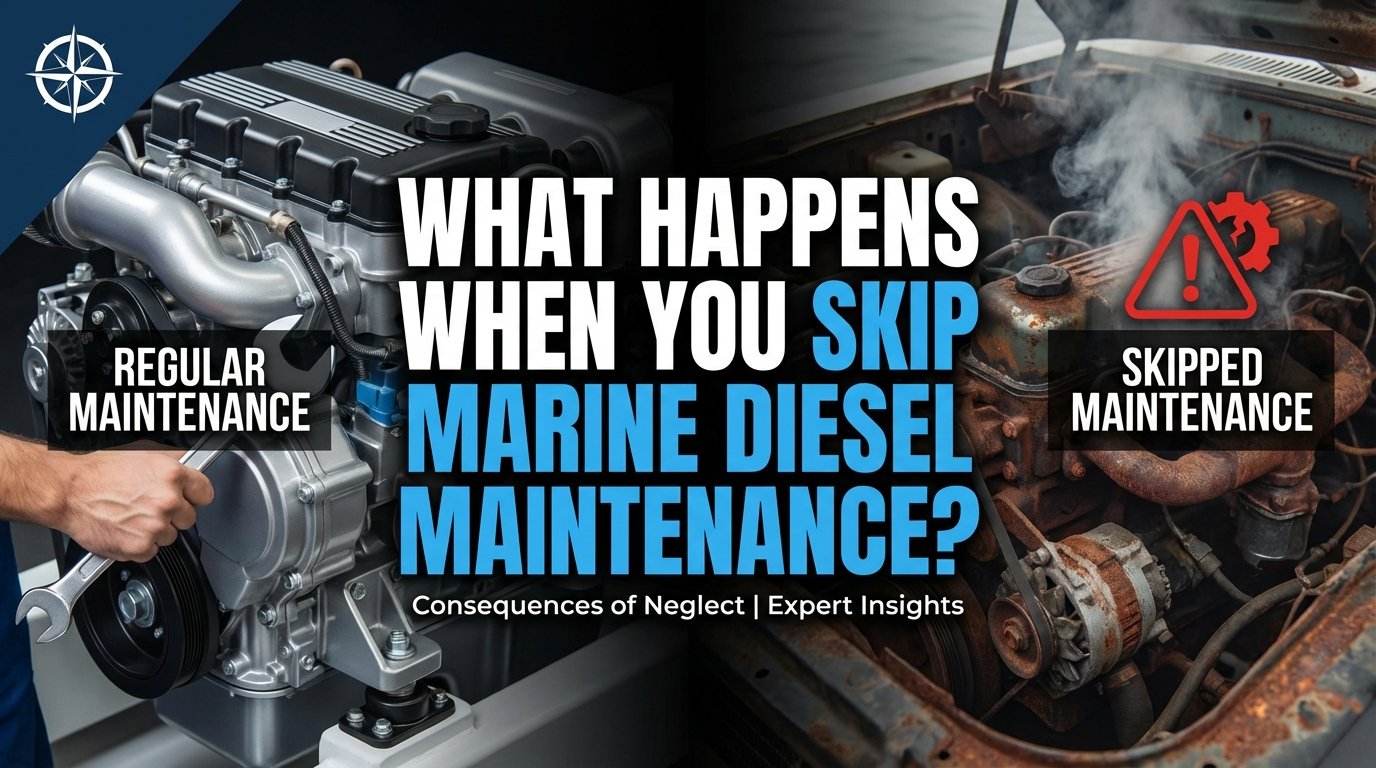
A preventable engine failure 50 miles offshore turns a perfect day into a dangerous emergency. The culprit? Skipped oil changes and ignored service intervals. While marine diesel engines are engineered for durability and long service lives, they’re not indestructible. Regular maintenance isn’t optional—it’s the difference between reliable performance and catastrophic breakdowns that can cost tens of thousands of dollars.
Understanding what actually happens inside your marine diesel engine when maintenance is neglected helps clarify why factory-authorized service schedules exist. These aren’t arbitrary recommendations designed to generate service revenue. They’re carefully calculated intervals based on engineering data, stress testing, and decades of real-world performance feedback from vessels operating in demanding conditions.
The Cascading Failures of Neglected Oil Changes
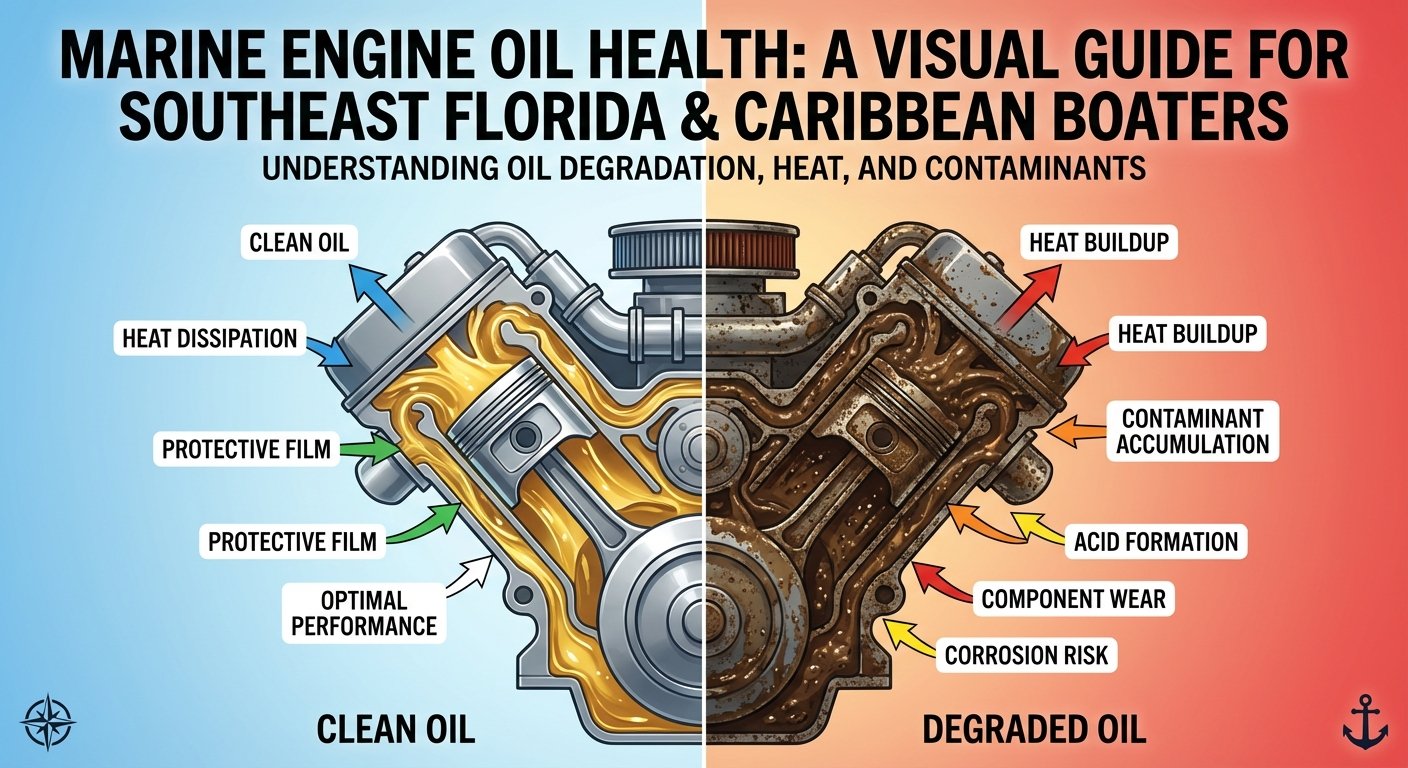
Engine oil serves multiple critical functions beyond simple lubrication. It captures combustion byproducts, neutralizes acids, suspends contaminants, and transfers heat away from critical components. When oil changes are skipped, these protective properties degrade progressively.
Initially, the oil’s additive package becomes depleted. Modern marine diesel oils contain detergents, dispersants, anti-wear compounds, and alkaline reserves that counteract the sulfuric and nitric acids formed during combustion. Once these additives are exhausted—typically well before most owners notice any change—acid accumulation begins attacking bearing surfaces and cylinder walls.
Simultaneously, the oil’s viscosity changes. Thermal breakdown and fuel dilution thin the oil, while soot loading and oxidation thicken it. Either condition reduces the protective oil film between moving parts. In MAN and Volvo Penta engines, which often run at higher specific outputs, this degraded protection leads to accelerated wear on turbocharger bearings, camshaft lobes, and piston rings.
The damage isn’t immediately catastrophic. Instead, clearances gradually increase as metal-to-metal contact removes microscopic material with each rotation. Over months, these tolerances grow from thousandths of an inch to measurable gaps. Oil pressure drops. Blow-by increases. Compression decreases. By the time symptoms become obvious, significant internal damage has already occurred.
What This Damage Costs
A complete engine rebuild for a mid-sized yacht diesel typically ranges from $25,000 to $75,000 in parts and labor. Turbocharger replacement alone can exceed $8,000. These aren’t maintenance expenses—they’re failure repairs that proper marine diesel maintenance would have prevented entirely. The irony is stark: skipping $500 oil changes eventually creates $50,000 problems.
Cooling System Neglect and Thermal Destruction
Marine diesel engines operate in uniquely challenging thermal environments. Raw water systems expose internal passages to salt, sediment, and biological growth. Closed cooling systems concentrate heat and dissolved minerals. Both require regular service that many owners postpone or ignore.
When raw water impellers aren’t replaced on schedule, they fail without warning. Rubber vanes crack, break off, and circulate through the cooling system. Some lodge in passages, creating hot spots. Others exit through the exhaust, leaving you unaware there’s a problem until the high-temperature alarm sounds—if it sounds at all.
Running a diesel engine even briefly without adequate cooling causes immediate damage. Aluminum cylinder heads warp at surprisingly low temperature differentials. Once warped, head gaskets fail, allowing coolant into cylinders or exhaust gases into the cooling system. On John Deere and Cummins engines, head replacements often exceed $15,000 including machine work and reassembly.
Closed cooling systems face different threats. Neglected coolant becomes acidic and loses its corrosion inhibitors. Electrolysis begins attacking aluminum components, particularly heat exchangers and thermostat housings. Owners often discover this only when coolant mysteriously disappears or when pink aluminum oxide appears in the expansion tank. By then, heat exchanger replacement—$3,000 to $8,000 depending on engine size—becomes necessary.
Fuel System Contamination and Injection Damage
Marine diesel fuel systems demand meticulous maintenance because they operate at extraordinary pressures. Common rail systems in modern engines like Volvo Penta’s D-series reach 30,000 PSI. At these pressures, even microscopic contamination causes disproportionate damage.
Skipped fuel filter changes allow water, biological growth, and particulate contamination to reach injection pumps and injectors. Water causes immediate corrosion in precision-machined components with clearances measured in microns. Biological growth—diesel algae—creates acidic byproducts that attack fuel system metallurgy while clogging filters and injector nozzles.
Injector failure symptoms often mimic other problems: rough running, black smoke, poor fuel economy. Many owners attempt troubleshooting while continuing to operate the engine, not realizing that running on damaged injectors contaminates the oil with unburned fuel and carbons, creating a second cascade of damage.
Professional diesel engine repair for fuel system contamination requires complete system flushing, tank cleaning, and typically injector replacement or rebuilding. For a twin-engine yacht, this service easily reaches $12,000 to $20,000. The preventive maintenance that would have avoided this? Regular filter changes costing perhaps $300 annually.
The Hidden Costs Beyond Repair Bills
Direct repair expenses tell only part of the story. Neglected marine diesel maintenance creates secondary costs that quickly multiply.
Lost Vessel Time
Major engine repairs require weeks or months, particularly when parts must be ordered and technicians scheduled. Throughout Southeast Florida and the Caribbean during peak season, factory-authorized service centers maintain full schedules. Emergency repairs jump the queue, but routine capacity remains limited. A boat sitting at the dock generates no fishing memories, no charter revenue, and no enjoyment—while still accruing dock fees, insurance, and loan payments.
Consequential Damage
Engine failures rarely affect only the engine. An overheated diesel that seized while docking might have caused collision damage. A dead generator in the Bahamas means spoiled provisions, dead batteries, and potentially damaged electronics. These secondary costs often exceed the primary repair.
Diminished Resale Value
Sophisticated buyers and surveyors recognize deferred maintenance immediately. Oil analysis showing elevated wear metals, cooling system deposits visible during inspection, or service records with conspicuous gaps all reduce negotiating positions. A vessel with documented factory-authorized maintenance from brands like MAN, Northern Lights, or Westerbeke commands premium pricing. One with questionable history sells at discount—if it sells at all.
The Compounding Effect of Multiple Neglected Systems
Marine diesel engines exist within interconnected systems. When multiple maintenance items are postponed simultaneously, failures compound in unpredictable ways.
Consider a common scenario: skipped oil changes coincide with ignored air filter service and delayed valve adjustments. The dirty air filter reduces airflow, increasing exhaust gas temperatures. Higher temperatures accelerate oil breakdown. Incorrect valve clearances—tight from carbon buildup—reduce compression and change combustion timing. This creates additional carbon formation, further affecting valve sealing. Meanwhile, the degraded oil fails to protect valve train components experiencing increased stress from the mistimed events.
This cascading deterioration doesn’t produce linear problems. Instead, damage accelerates exponentially. An engine that might have run another 500 hours with proper maintenance might fail catastrophically in 100 hours when multiple systems are neglected simultaneously.
What Proper Maintenance Actually Prevents
Factory-authorized yacht engine service following manufacturer schedules prevents specific, predictable failure modes:
- Bearing failures from contaminated or degraded lubricants
- Turbocharger damage from oil coking and bearing wear
- Injection system failures from fuel contamination and water intrusion
- Cooling system corrosion from depleted inhibitor packages
- Valve train wear from incorrect clearances and carbon deposits
- Electrical system degradation from loose connections and corrosion
- Exhaust component failure from overheating and saltwater exposure
Each of these represents a multi-thousand-dollar repair that routine maintenance costing hundreds of dollars would prevent. The mathematics are compelling, yet many owners still defer service—often until facing those exact expensive repairs.
Why Professional Service Matters
Some maintenance tasks appear deceptively simple. Changing oil, replacing filters, checking belts—these seem manageable for mechanically inclined owners. However, professional technicians provide value far beyond basic mechanical procedures.
Factory-authorized service includes diagnostic elements that prevent problems from developing. Technicians trained on Kohler, Onan, and other specific brands recognize early warning signs: slight changes in vibration characteristics, barely perceptible oil odors, subtle variations in operating temperature. They identify these during routine service, before they become failures.
Professional boat engine troubleshooting also includes proper documentation. Detailed service records provide baseline data for trend analysis. Gradual increases in oil consumption, slow rises in coolant temperature, or progressive changes in exhaust color all signal developing issues when tracked over time. Without professional records, these trends remain invisible until failure occurs.
Geographic Considerations for Southeast Florida and Caribbean Vessels
Tropical marine environments accelerate certain failure modes. Higher ambient temperatures stress cooling systems. Warm water provides ideal conditions for biological growth in fuel tanks. Salt air accelerates electrical corrosion. These factors don’t eliminate the need for maintenance—they make it more critical and often require shorter intervals than manufacturer base recommendations.
Vessels operating between Southeast Florida and Caribbean destinations face additional challenges. Varying fuel quality across different ports introduces contamination risks. Extended passages place sustained loads on engines. Limited access to parts in remote anchorages means failures become major expeditions rather than minor inconveniences.
Dockside service availability throughout this region provides significant advantage. Rather than arranging haul-outs or traveling to repair facilities, factory-authorized technicians come to your vessel, performing comprehensive maintenance while you remain in the water. This convenience eliminates excuses for deferred service while reducing the total time your vessel remains unavailable.
Making the Economics Work in Your Favor
Proper marine diesel engine maintenance costs approximately 2-4% of engine replacement value annually. For a $40,000 engine, that’s $800 to $1,600 per year. Neglecting this maintenance doesn’t eliminate the expense—it concentrates it into catastrophic failures costing multiples of the preventive service investment.
Viewed across a typical 20-year ownership period, maintained engines require perhaps $30,000 in scheduled service. Neglected engines require that same amount plus major repairs averaging another $40,000 to $70,000. The maintained engine also retains significantly more value at resale, further improving the economic equation.
Protecting Your Investment
Marine diesel engines represent substantial investments in reliability, range, and capability. Whether powering a sportfisher, cruising yacht, or commercial vessel, these engines deserve protection through consistent, professional maintenance following factory-authorized schedules.
The consequences of skipped maintenance aren’t theoretical—they’re predictable, preventable, and expensive. Every deferred oil change, postponed filter replacement, or ignored service interval moves your engine closer to failure. The question isn’t whether neglected maintenance causes problems, but when those problems will occur and how much they’ll cost.
Don’t wait for warning signs or minor problems to become major failures. Contact DSOA today for comprehensive marine diesel maintenance serving Southeast Florida and the Caribbean. Our factory-authorized technicians provide dockside service for MAN, Volvo Penta, John Deere, Cummins, Kohler, Northern Lights, and Westerbeke engines and generators, with worldwide parts shipping capability. Schedule your service now and protect your investment from the cascading failures that deferred maintenance inevitably creates.
