
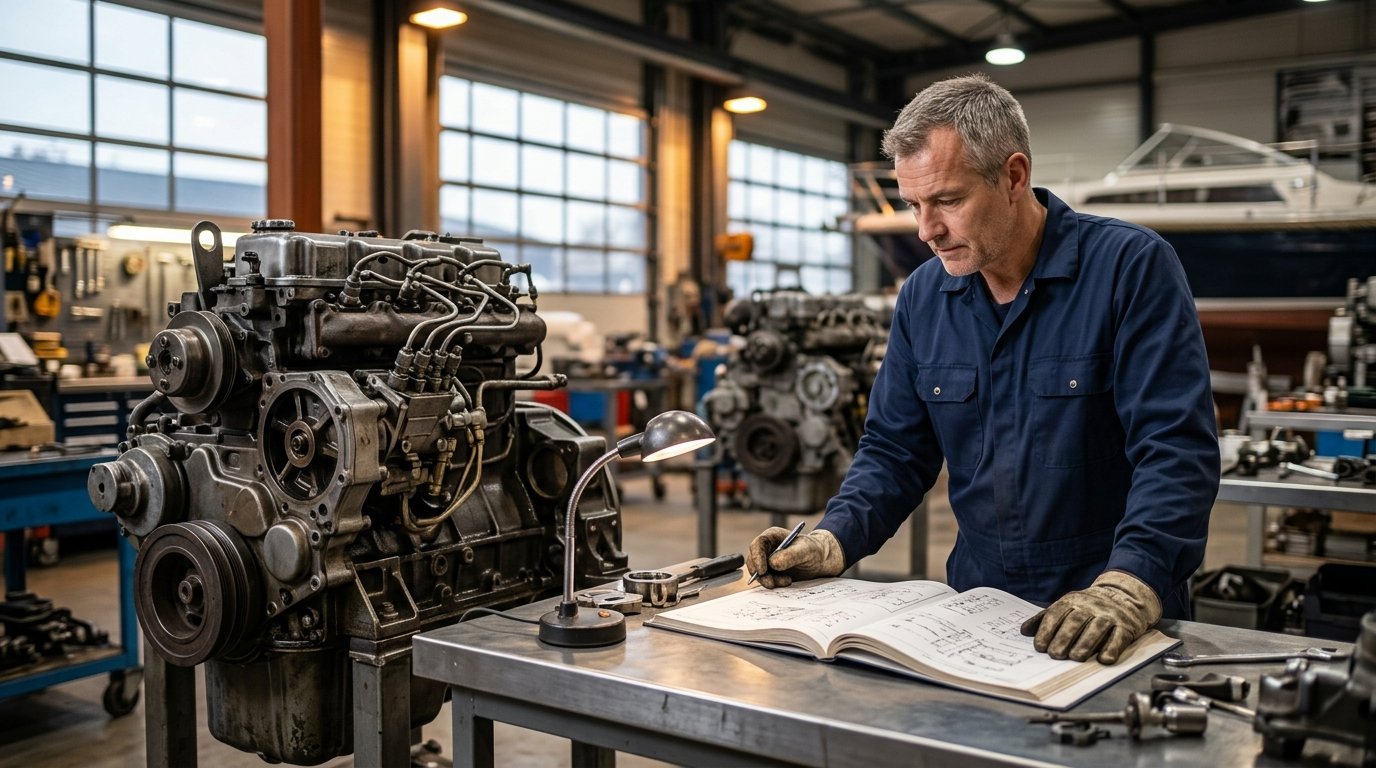
Your yacht’s engine has been running rough, oil consumption is climbing, and your last survey flagged some concerns. Now you’re facing the question that every serious boat owner eventually confronts: is it time to rebuild the engine you have, or replace it entirely? This isn’t a simple call, and the wrong decision can cost you tens of thousands of dollars—or leave you stranded offshore.
The rebuild-versus-replace decision involves more than comparing price tags. Engine condition, vessel age, intended use, parts availability, and long-term ownership plans all factor in. Here’s a structured way to think through it.
Understanding What Each Option Actually Means
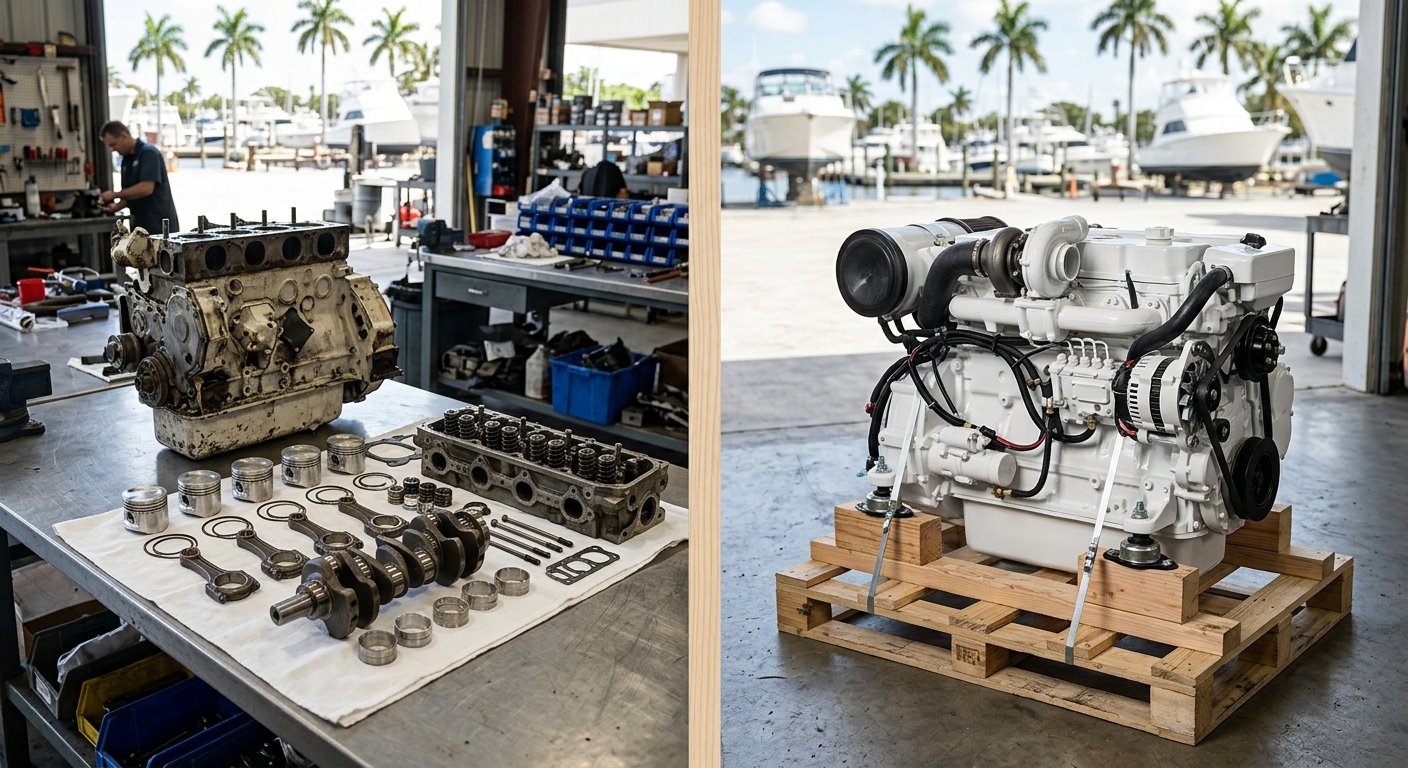
Before weighing costs, it helps to clarify what “rebuild” and “replace” actually involve in a marine diesel context.
Marine Engine Rebuild (Overhaul)
A diesel engine overhaul involves disassembling the engine, inspecting every component, replacing worn or damaged parts, and reassembling it to manufacturer specifications. Depending on the extent of wear, this can range from a “top-end” overhaul—replacing injectors, head gaskets, valve seats, and related components—to a full bottom-end rebuild that includes crankshaft bearings, pistons, rings, and cylinder liners.
A properly executed marine engine rebuild can restore an engine to near-original performance. The key word is “properly.” Factory-authorized technicians working to OEM specifications, using genuine manufacturer parts, produce significantly better outcomes than cut-rate rebuilds using generic components.
Marine Diesel Engine Replacement
Replacement means sourcing and installing a new or remanufactured engine. This could be an identical factory-fresh unit, a factory-remanufactured (reman) engine from the OEM, or a repowering scenario where you upgrade to a different, often more capable engine. If you’ve been researching marine diesel engines for sale or exploring yacht engine sales in Florida, you already know the range of options and price points available today.
Key Factors That Determine the Right Choice
Engine Hours and Condition
Hours alone don’t tell the whole story—maintenance history matters just as much. A MAN or Volvo Penta engine with 8,000 hours and impeccable service records may have more usable life remaining than a comparably sized engine at 3,500 hours that was poorly maintained. Compression tests, oil analysis, and borescope inspection give technicians a far more accurate picture than the hour meter alone.
According to the American Boat and Yacht Council (ABYC), systematic engine condition evaluation—not hour-based assumptions—should drive major service decisions. This is exactly how DSOA’s factory-authorized technicians approach diagnostics before recommending either path.
If inspection reveals that internal wear is isolated—say, a damaged cylinder head on an otherwise healthy block—a targeted overhaul makes clear economic sense. If wear is widespread across multiple systems simultaneously, replacement often delivers better long-term value.
The Cost Calculus
A common industry benchmark is the “50% rule”: if the cost of repair or rebuild exceeds 50% of replacement value, replacement becomes the more rational economic choice. This isn’t absolute, but it’s a useful starting point.
Consider these cost layers for a rebuild:
- Labor for complete disassembly, inspection, and reassembly
- OEM parts (heads, bearings, rings, injectors, seals, gaskets)
- Machine shop work if block or crankshaft require resurfacing
- Ancillary systems—heat exchangers, raw water pumps, turbochargers—often need attention simultaneously
For replacement, factor in:
- Engine purchase price (new or factory reman)
- Installation labor, which on larger yachts can be substantial
- Alignment, commissioning, and sea trial
- Possible modifications to engine mounts or exhaust systems
Get a thorough, itemized estimate for both paths before deciding. DSOA provides detailed diagnostic assessments so Palm Beach and Broward County boat owners can make this comparison accurately, not based on guesswork.
Parts Availability for Your Engine Brand
This factor is often underestimated. Some older marine diesel platforms have robust OEM parts support decades into their production life; others become increasingly difficult to source as manufacturers transition to newer platforms. For engines like Cummins/Onan, John Deere, Kohler, Northern Lights, Westerbeke, MAN, and Volvo Penta—brands DSOA is factory-authorized to service—parts availability is generally strong. But for older variants within these families, availability can vary significantly.
If you’re rebuilding an engine where critical parts require extended lead times or are no longer manufactured, a replacement with a current-generation engine may be the smarter long-term investment. DSOA’s worldwide parts shipping capability means we can source components globally when needed, but parts scarcity remains a legitimate factor in the rebuild decision.
Vessel Age and Ownership Timeline
How long do you plan to keep the boat? If you’re planning to sell within two or three years, a full engine replacement adds clear, demonstrable value to a survey and buyer inspection. A rebuilt engine can also satisfy buyers, but only when documented thoroughly with OEM parts records and factory-authorized labor.
If you’re keeping the vessel long-term, the calculus shifts. A successful rebuild on a structurally sound vessel can deliver another 8,000 to 12,000 hours of reliable service—comparable to a new engine—at a fraction of the replacement cost, provided the block is in serviceable condition.
Generator Engines: A Different Consideration
The rebuild-versus-replace decision applies equally to marine generator engines—Cummins/Onan, Kohler, Northern Lights, and Westerbeke units being the most common aboard yachts in this region. Generator engines typically accumulate hours differently than propulsion engines, often running longer continuous cycles and in more thermally consistent conditions. This sometimes means generator engines are better rebuild candidates, particularly when the generating end (alternator assembly) is in good condition and replacement of just the engine block assembly is practical.
When Rebuilding Makes Clear Sense
- Wear is localized—cylinder head issues, injector wear, or top-end components only
- The block and crankshaft are within serviceable tolerances
- Engine is a well-supported platform with strong OEM parts availability
- You plan to keep the vessel for five or more years
- Total rebuild cost is well below 50% of a replacement engine installed
When Replacement Makes Clear Sense
- Block damage, severe bore wear, or cracked components make a rebuild impractical
- The engine is an older platform with declining parts support
- Rebuild costs approach or exceed the cost of a factory-reman or new engine
- You’re considering a power upgrade or repowering to a more fuel-efficient platform
- You’re preparing the vessel for sale and want the strongest possible survey result
The Boat Owners Association of the United States (BoatUS Foundation) notes that propulsion system reliability is consistently among the top factors affecting resale value and buyer confidence in pre-owned vessel transactions—making the documentation of either path critically important.
The Value of Factory-Authorized Diagnosis
One of the most common mistakes boat owners make is getting this decision from someone who has a financial interest in one outcome. An independent shop may lean toward whatever generates more labor hours. A parts dealer naturally steers toward replacement. A factory-authorized service center like DSOA is positioned to give you the honest diagnostic picture—because our reputation is built on correct long-term outcomes, not short-term invoice totals.
Factory-authorized technicians work to OEM specifications and have direct access to manufacturer technical service bulletins, tolerances, and rebuild standards. This matters enormously in a diesel engine overhaul. The difference between a bearing clearance that’s within spec and one that’s marginally out of spec can determine whether your rebuild lasts 10,000 hours or begins showing problems within 500.
Whether you ultimately choose a comprehensive marine engine repair, a full overhaul, or source a new or remanufactured engine through DSOA, the starting point should always be a thorough, manufacturer-standard diagnostic evaluation. Our dockside service capability throughout Palm Beach and Broward Counties means that evaluation can happen where your vessel is located—without the logistics and expense of hauling unnecessarily.
For an overview of how engine condition assessments integrate with broader on-site diesel marine engine service, DSOA brings the diagnostic process directly to your marina berth.
Frequently Asked Questions
How do I know if my marine diesel engine is a good rebuild candidate?
The best way is a professional diagnostic evaluation that includes compression testing, oil analysis, and borescope inspection. If the engine block and crankshaft are within manufacturer tolerances and wear is localized to upper-end components, a rebuild is typically viable. Widespread internal wear or block damage usually points toward replacement.
What is a diesel engine overhaul, and how extensive is it?
A diesel engine overhaul can range from a top-end service—replacing injectors, head gaskets, valve seats, and related components—to a complete bottom-end rebuild involving pistons, rings, bearings, and cylinder liners. The scope is determined by what inspection reveals, not by a one-size-fits-all approach.
Are factory-remanufactured engines as good as new?
Factory-remanufactured engines from OEMs like Cummins, Volvo Penta, or MAN are rebuilt to original engineering specifications using new or reconditioned OEM components. They typically carry warranties comparable to new engines and represent a strong value proposition when a rebuild isn’t practical and a full new engine exceeds the budget.
How long does a marine engine rebuild typically last?
A properly executed rebuild using OEM parts and factory-authorized labor can restore an engine to near-original service life. Many rebuilt marine diesels deliver thousands of additional hours of reliable operation. Longevity depends heavily on post-rebuild maintenance adherence and operating conditions.
Does DSOA offer dockside service for engine diagnostics and repairs?
Yes. DSOA provides dockside service throughout Palm Beach and Broward Counties, meaning our factory-authorized technicians can perform diagnostics, maintenance, and many repair procedures at your marina slip. This eliminates unnecessary haulouts and keeps your schedule on track.
Make the Right Call With Expert Guidance
The rebuild-versus-replace decision is too consequential to make on gut instinct or general internet searches. It requires a hands-on assessment by technicians who understand your specific engine platform, have access to manufacturer specifications, and can give you an unbiased recommendation based on what the inspection actually shows.
DSOA has served the Southeast Florida and Caribbean boating community for four decades as a factory-authorized service center for MAN, Volvo Penta, John Deere, Cummins/Onan, Kohler, Northern Lights, and Westerbeke. Contact us today to schedule a diagnostic evaluation—and get a clear, honest answer about the best path forward for your vessel.
