
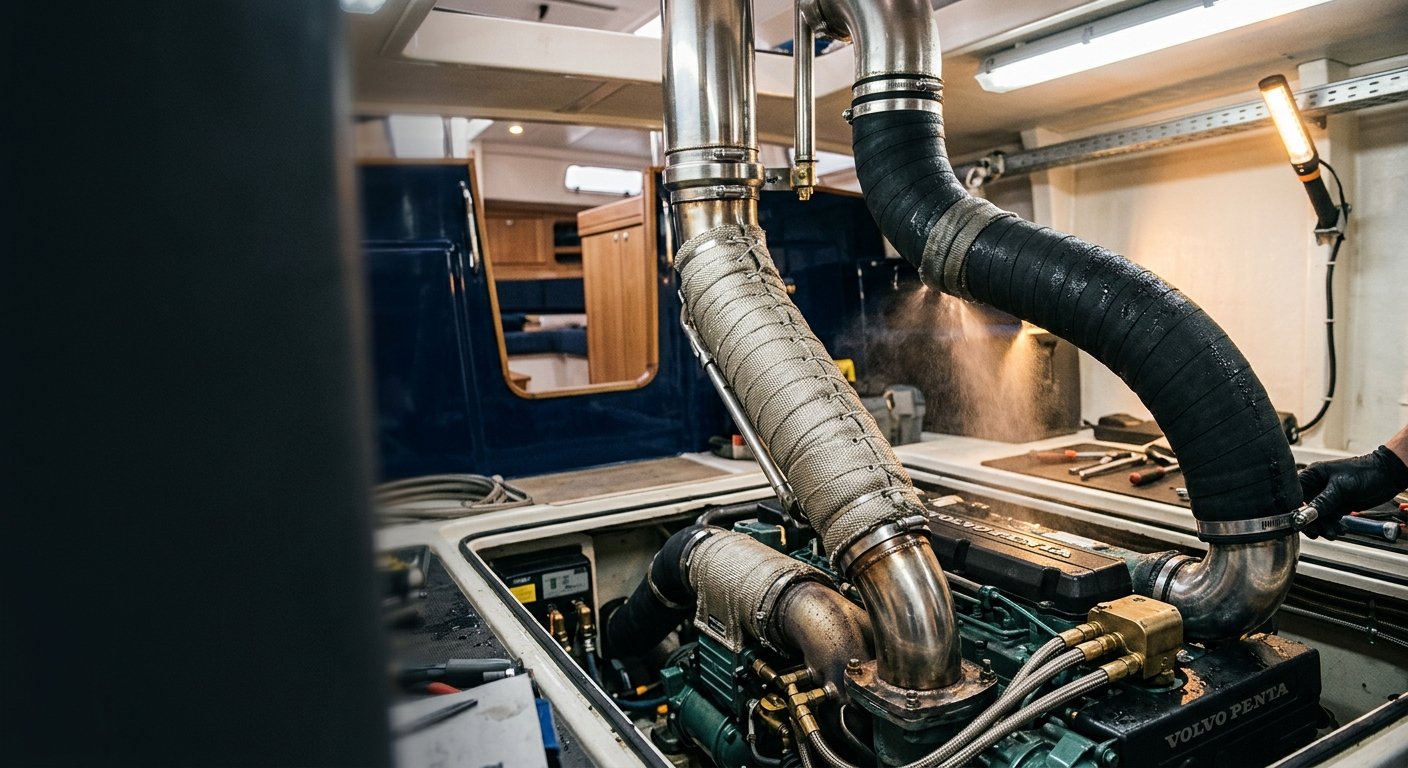
Marine diesel engines use one of two exhaust system designs: wet exhaust, where seawater is injected into the exhaust stream to cool and silence it, or dry exhaust, where hot gases exit through insulated piping without water cooling. Wet exhaust systems dominate recreational and mid-sized commercial vessels for their compact size and lower surface temperatures, while dry exhaust systems are preferred on larger yachts and high-output workboats where performance and durability under sustained load matter most.
- Wet exhaust systems cool exhaust gases with raw seawater, reducing noise and surface heat — ideal for most recreational vessels.
- Dry exhaust systems expel hot, uncooled gases through insulated pipes and are better suited for high-load, large-vessel applications.
- Each system has distinct maintenance requirements; neglecting either significantly shortens engine life.
- Factory-authorized technicians can identify early failure signs in both systems that are easy to miss during routine visual checks.
- Southeast Florida’s saltwater environment accelerates corrosion in wet exhaust components — proactive inspections matter here.
How Wet Exhaust Systems Work
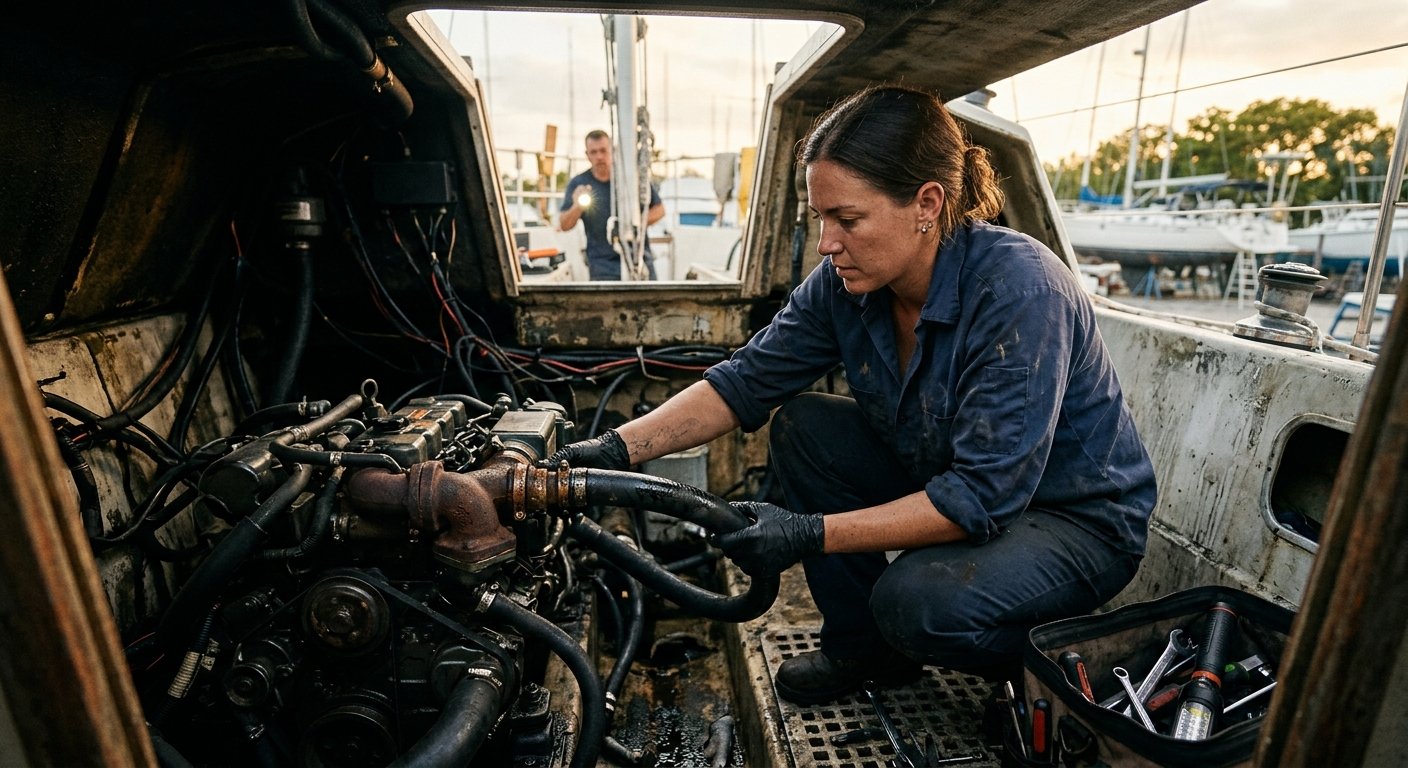
In a wet exhaust system, a raw-water pump draws seawater from outside the hull and injects it into the exhaust stream at a component called the mixing elbow (also called the water-injected elbow). This injection cools the exhaust gases from several hundred degrees down to near ambient temperature and simultaneously muffles the sound. The cooled, water-laden exhaust then flows through a rubber or fiberglass hose into a waterlock muffler, which prevents water from siphoning back into the engine, and exits through the transom or hull.
This design keeps exhaust hose surfaces cool enough to touch, eliminates the need for heavy insulation, and reduces overall engine compartment heat. That’s why the vast majority of diesel-powered cruisers, express yachts, and sportfishing boats you see in Palm Beach County and Broward County marinas rely on wet exhaust. The components are compact, the installation cost is moderate, and the system integrates naturally with the raw-water cooling circuit already present on every marine diesel.
Wet Exhaust Components and Their Roles
- Raw-water pump: The heartbeat of the system; drives cooling water into the exhaust stream.
- Mixing elbow: The steel or cast-iron junction where water meets exhaust — the highest-wear component in the system.
- Waterlock muffler: Holds water when the engine stops, preventing backflow into cylinders.
- Exhaust hose: Must be specifically rated for wet marine exhaust; standard automotive hose is not acceptable.
- Anti-siphon valve: Prevents raw water from flooding the engine if the exhaust loop height is inadequate.
A clogged or failed raw-water pump means no cooling water reaches the mixing elbow. Exhaust temperatures spike rapidly, potentially melting rubber hoses, scorching fiberglass, or allowing seawater to back-siphon into the engine. This is one of the most common — and most preventable — causes of serious marine diesel damage.
How Dry Exhaust Systems Work

Dry exhaust systems remove hot combustion gases without injecting any water into the exhaust path. Instead, high-temperature gases travel through rigid steel, stainless steel, or titanium piping that is heavily insulated with lagging or a water-jacketed outer sleeve. The exhaust exits through the hull, transom, or — on larger vessels — through deck-level stacks. Temperatures inside a dry exhaust pipe can exceed 700°F, which makes proper insulation and clearances from combustible materials non-negotiable.
Larger motor yachts, commercial vessels, and high-performance sport yachts often favor dry exhaust because it imposes less back-pressure on the engine at high sustained loads, handles higher exhaust volumes more efficiently, and provides access to a distinctive, throaty exhaust note that many owners prefer. Engines like the MAN marine diesel lineup are frequently paired with dry exhaust systems on larger superyacht and performance applications where power output demands it.
Dry Exhaust Components and Their Roles
- Exhaust manifold: Collects gases from engine cylinders — must be marine-grade and rated for continuous high-temperature operation.
- Rigid exhaust piping: Steel or stainless — never flexible without engineering approval for specific bends.
- Insulation lagging or water jacket: Reduces surface temperature and protects surrounding structure.
- Flexible bellows section: Absorbs engine vibration and prevents stress fractures in the rigid piping.
- Through-hull or stack fitting: The exit point, which must be properly positioned to prevent exhaust ingestion by HVAC or air intakes.
| Criterion | Wet Exhaust | Dry Exhaust |
|---|---|---|
| Surface temperature | Cool to the touch | Extremely hot — requires insulation |
| Back-pressure | Moderate (water adds resistance) | Low (ideal for high-output engines) |
| Noise level | Quieter (water muffles sound) | Louder — may need silencers |
| Maintenance complexity | Raw-water components, hoses, elbow | Insulation, rigid piping, flexible sections |
| Typical application | Cruisers, sportfishers, mid-size yachts | Large yachts, commercial, high-performance |
| Saltwater corrosion risk | Higher (seawater flows through system) | Lower (no water in exhaust path) |
Maintenance Requirements for Each System
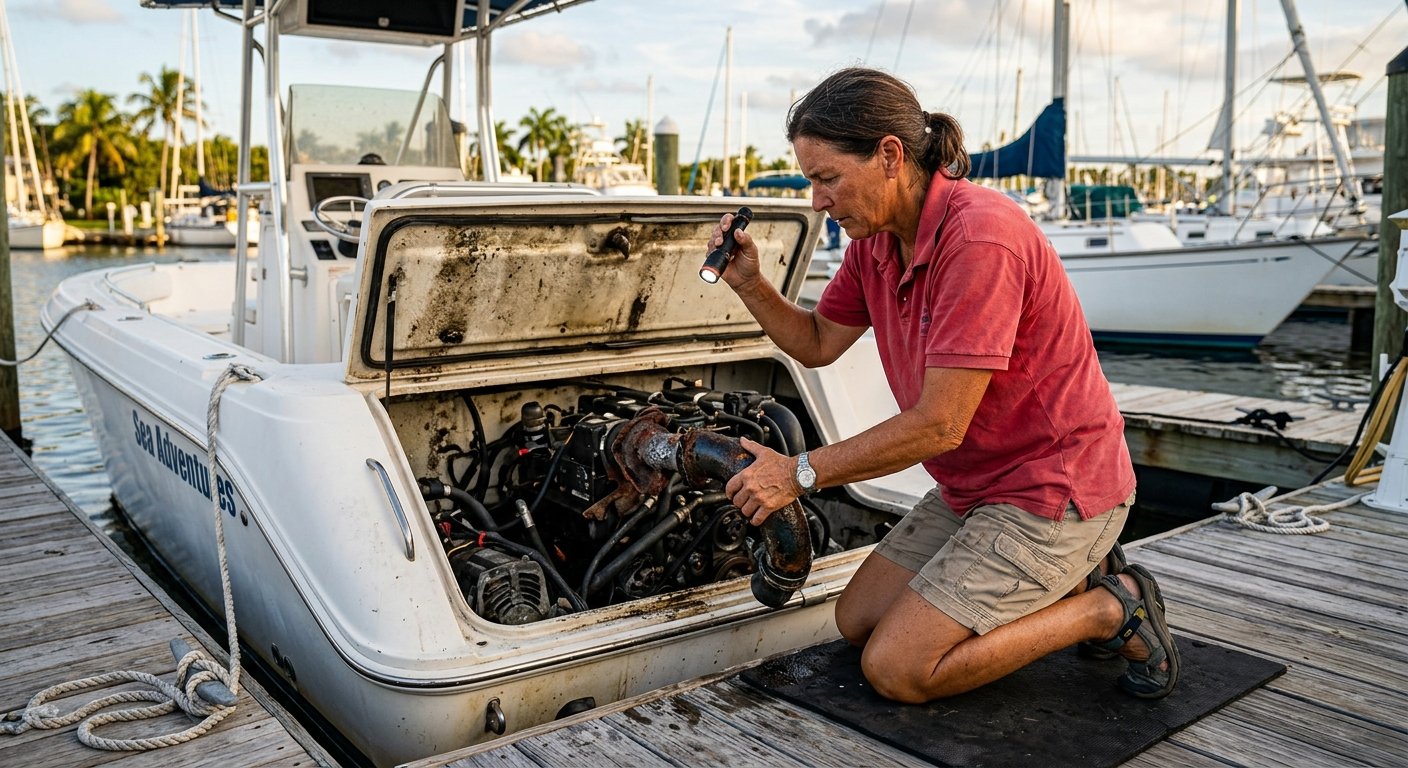
Understanding which system your vessel uses is only the first step. Maintaining it correctly — and on schedule — is what keeps your engine running reliably in Southeast Florida’s demanding saltwater environment.
Wet Exhaust Maintenance Priorities
The mixing elbow is the single most failure-prone component in any wet exhaust system. Constant exposure to hot exhaust gases and saltwater creates the ideal conditions for accelerated corrosion. According to the American Boat and Yacht Council (ABYC), whose standards govern marine exhaust system design and installation, mixing elbows should be inspected at every major service interval and replaced proactively based on observed wear — not after failure. Most technicians recommend replacement every two to four years depending on engine hours and water quality.
Raw-water impellers in the pump should be replaced annually as a matter of routine. Waiting for visible signs of impeller failure is a reactive strategy that often results in overheating incidents. Exhaust hoses should be checked for softening, cracking, or any sign of charring — all indicators that cooling water flow is insufficient or intermittent.
If you’re commissioning a Volvo Penta, Cummins, or John Deere marine diesel after a period of storage, have a technician flow-test the raw-water circuit before starting the engine. Stagnant water can leave mineral deposits that restrict flow without fully blocking it — enough to allow overheating under load.
Dry Exhaust Maintenance Priorities
Dry exhaust systems demand rigorous inspection of insulation integrity and rigid pipe connections. Insulation lagging that becomes wet, compressed, or mechanically damaged loses its thermal protection rapidly — a problem that can go unnoticed until nearby structure begins to discolor or smell. Flexible bellows sections should be checked for cracking, especially at the ends where clamping stress is highest.
Stack or through-hull fittings should be inspected annually for corrosion and proper sealing. Even though seawater doesn’t flow through a dry exhaust, condensation and coastal humidity create their own corrosion pathways. Carbon soot accumulation inside pipes should be documented at each service interval; unusual buildup patterns can signal injector issues or abnormal combustion worth investigating further.
The exhaust system is the engine’s voice — and the signs it sends are worth listening to before they become expensive repairs.
Choosing the Right System for Your Vessel
This is rarely a decision made from scratch unless you’re building or re-powering a vessel. Most owners inherit the exhaust system configuration their boat came with from the factory. However, if you’re repowering with a higher-output engine — say, upgrading to a larger MAN, Kohler, or Northern Lights diesel — it’s worth evaluating whether the existing exhaust system design is still appropriate for the new engine’s output and back-pressure tolerances.
Our diesel marine engine repair services include exhaust system assessment as part of any major engine service or repowering consultation. Understanding the interaction between your engine and exhaust system is fundamental to getting reliable performance — and to avoiding the kind of failures that sideline vessels at the worst possible times.
For generator applications — whether you’re running a Cummins/Onan, Westerbeke, or Northern Lights genset — exhaust system configuration matters just as much as for propulsion engines. Generators run for extended periods under sustained load, which stresses exhaust components differently than propulsion cycles. If you haven’t had your genset exhaust inspected recently, it belongs on your next service checklist. Our marine diesel service and repair team handles both propulsion and generator exhaust systems across all our authorized brands.
Frequently Asked Questions
How do I know if my boat has a wet or dry exhaust system?
The simplest indicator is what comes out of your exhaust outlet when the engine is running. Wet exhaust systems discharge a steady stream of water mixed with exhaust. Dry exhaust systems emit only hot gases and visible heat distortion. You can also follow the exhaust piping from the engine — if you see rubber hose leading to a muffler canister, it’s a wet system; rigid insulated metal piping indicates a dry system.
How often should a mixing elbow be replaced on a wet exhaust system?
Most factory-authorized technicians recommend inspecting the mixing elbow annually and replacing it every two to four years depending on engine hours, operating conditions, and observed corrosion. Saltwater environments like Southeast Florida accelerate wear. Replacing the elbow before failure is significantly less expensive than repairing damage caused by overheating.
Can I upgrade from a wet exhaust to a dry exhaust system?
It’s technically possible but involves significant engineering work, including heat shielding, insulation, new through-hull or stack penetrations, and a thorough review of clearances from combustible materials. Any such conversion should be designed and installed by factory-authorized marine technicians and must comply with ABYC exhaust standards. It’s not a casual upgrade — but in some repowering scenarios, it’s the right choice.
What are the warning signs of an exhaust system problem?
Watch for black smoke or excessive white smoke from the exhaust, unusual exhaust odor inside the cabin, discolored or blistered fiberglass near exhaust outlets, reduced raw-water flow visible at the exhaust discharge, or any evidence of heat damage on nearby components. These symptoms warrant immediate professional inspection — operating with a compromised exhaust system can cause rapid engine damage.
Does DSOA service exhaust systems on generators as well as propulsion engines?
Yes. DSOA services exhaust systems on both propulsion engines and marine generators across all our authorized brands, including Cummins/Onan, Westerbeke, Kohler, and Northern Lights. Generator exhaust systems are subject to the same failure modes as propulsion systems and deserve the same proactive maintenance attention.
Professional Exhaust System Service in Southeast Florida
Whether your vessel runs a wet exhaust, dry exhaust, or a combination system across multiple engines and generators, the exhaust system is not where to defer maintenance. In Palm Beach County and Broward County’s saltwater environment, corrosion moves faster than most owners expect — and a failed mixing elbow or compromised insulation lagging rarely gives much warning before the situation becomes serious.
DSOA’s factory-authorized technicians bring decades of hands-on experience with every exhaust configuration found on MAN, Volvo Penta, John Deere, Cummins/Onan, Kohler, Northern Lights, and Westerbeke powered vessels. Our on-site dockside service means we come to your vessel — no hauling required for inspections and most service work. And with worldwide parts shipping capability, we can source the right components for your specific system quickly, whether you’re in Fort Lauderdale, Palm Beach, or provisioning for a Caribbean passage.
Schedule Your Exhaust System Inspection
Contact DSOA to book a factory-authorized inspection of your marine diesel exhaust system — dockside service available throughout Palm Beach and Broward Counties.

About DSOA
DSOA provides factory-authorized marine diesel engine and generator maintenance, repair, and parts services to boat and yacht owners throughout Southeast Florida and the Caribbean. With four decades of expertise servicing premium brands including MAN, Volvo Penta, John Deere, Cummins/Onan, Kohler, Northern Lights, and Westerbeke, DSOA combines authoritative technical knowledge with convenient dockside service. The company serves both experienced yacht owners and newer boaters with professional, educational guidance on proper engine care and preventive maintenance, backed by worldwide parts shipping capability. Visit dieselservicesofamerica.com →
