
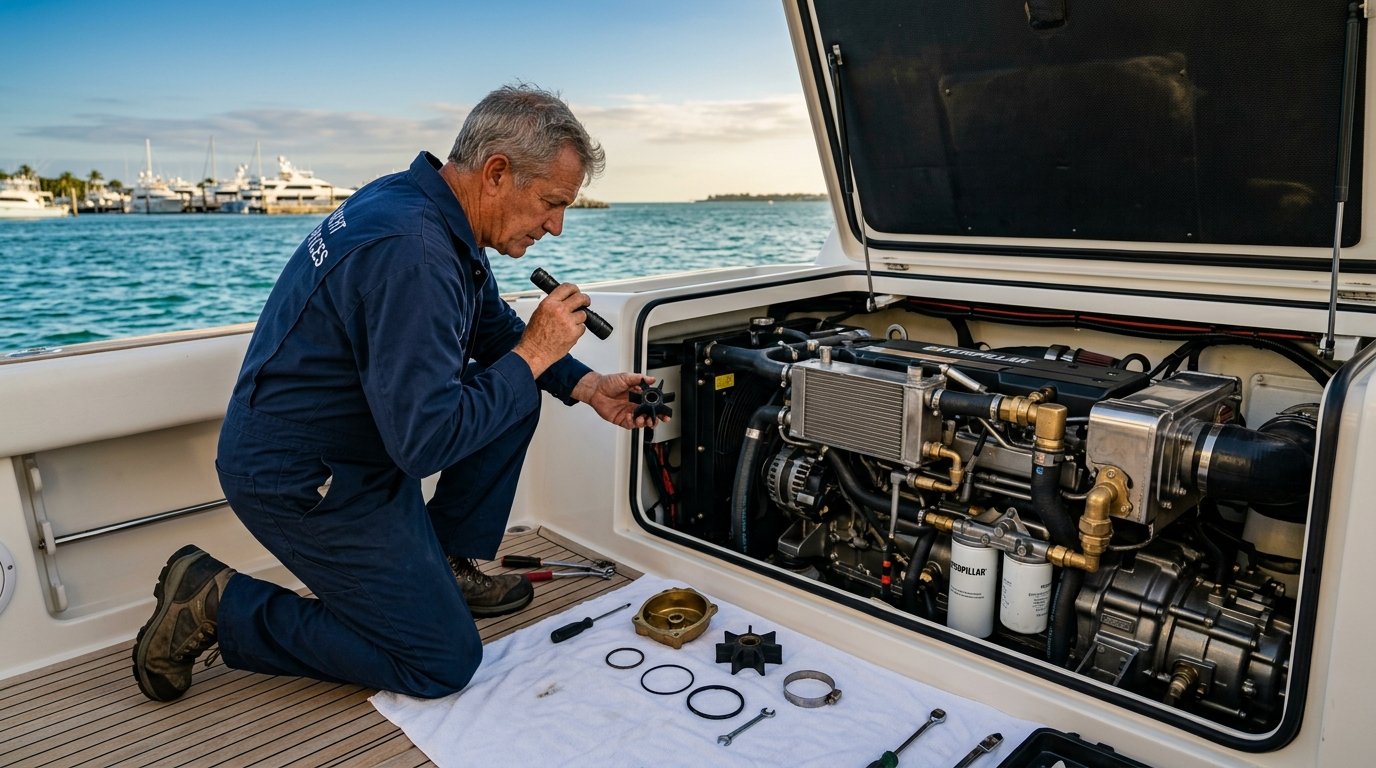
Overheating is the single most common cause of serious marine diesel engine damage—and it’s almost entirely preventable. Whether you’re running a MAN or Volvo Penta propulsion system or depend on a Cummins/Onan or Kohler generator for life aboard, your cooling system is the unsung guardian of every critical component inside that engine. When it fails, the consequences range from a ruined afternoon on the water to a catastrophic—and expensive—engine rebuild.
Understanding how your marine diesel cooling system works, what it needs to stay healthy, and when to call in a factory-authorized technician is essential knowledge for any serious boat owner in Palm Beach County, Broward County, or anywhere across the Caribbean. Here’s what you need to know.
How Marine Diesel Cooling Systems Work
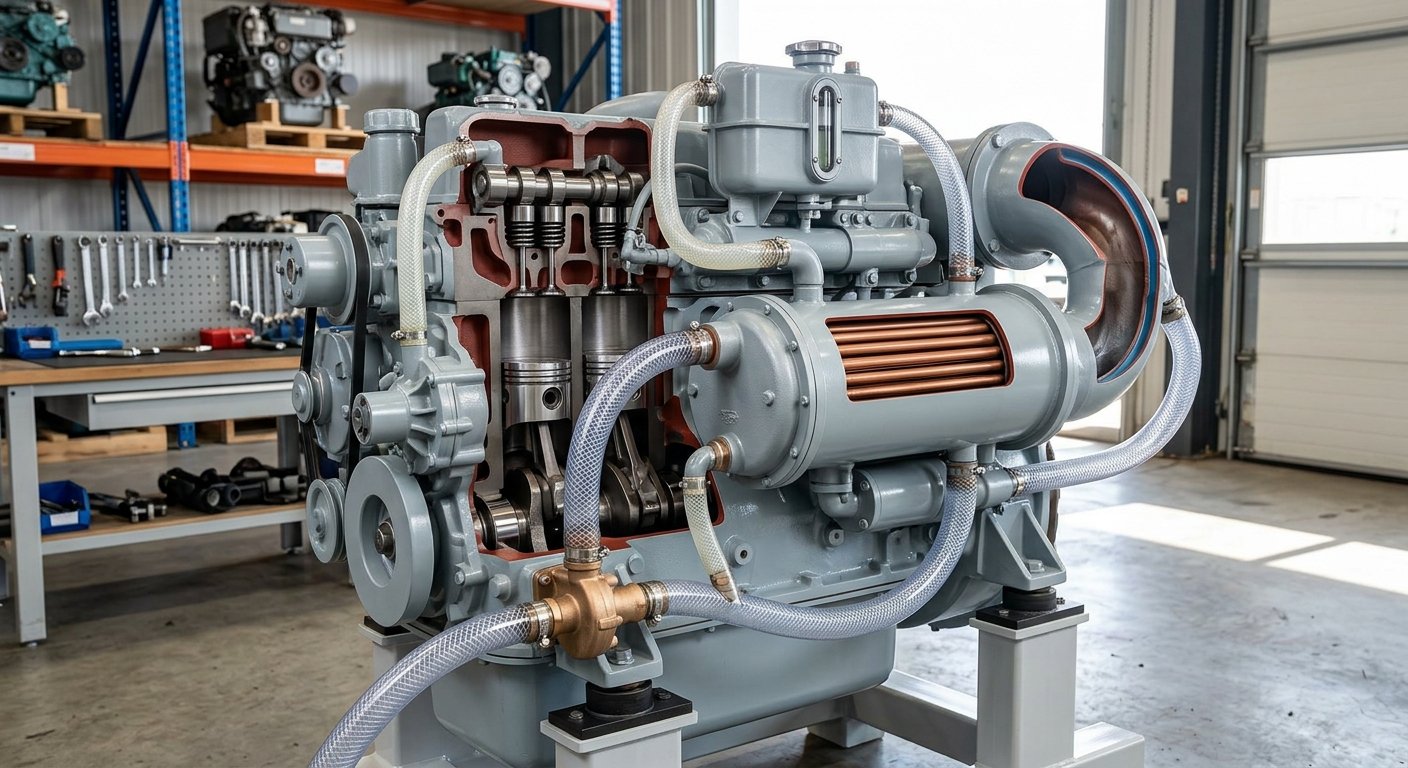
Most marine diesel engines use a two-circuit cooling system: a raw water circuit and a freshwater (closed) circuit. Raw water—drawn directly from the surrounding ocean or inlet—flows through a heat exchanger and exhaust system components to carry heat away from the engine. The closed freshwater circuit circulates treated coolant through the engine block itself, maintaining precise operating temperatures without exposing internal components to corrosive saltwater.
Generators from brands like Northern Lights, Westerbeke, and Cummins/Onan follow similar principles, though the specific configuration varies by model and application. Understanding this dual-circuit design helps explain why cooling system problems can originate from multiple places—and why diagnosing them correctly requires experience with the specific engine platform involved.
The Most Critical Marine Engine Cooling Parts
Every component in the cooling circuit plays a role. These are the marine engine cooling parts that demand the most attention:
- Raw water impeller: This rubber impeller sits inside the raw water pump and is the most frequently serviced cooling component on any marine diesel. It degrades over time, especially when run dry even briefly. Most manufacturers recommend annual replacement regardless of visible condition.
- Heat exchanger: Transfers heat between the raw water and closed coolant circuits. Internal fouling from scale, debris, or biological growth restricts flow and reduces efficiency over time.
- Thermostat: Regulates coolant temperature by controlling flow through the engine. A stuck-closed thermostat causes rapid overheating; a stuck-open thermostat prevents the engine from reaching proper operating temperature, leading to incomplete combustion and accelerated wear.
- Raw water strainer: Filters debris from incoming seawater before it reaches the impeller and heat exchanger. A clogged strainer is one of the most common causes of sudden overheating.
- Zincs and anodes: Sacrificial anodes inside the heat exchanger protect the unit from galvanic corrosion. When they’re depleted and not replaced, the heat exchanger itself becomes the sacrificial component—an expensive mistake.
- Coolant (antifreeze): Even in Southeast Florida’s warm climate, coolant serves critical functions beyond freeze protection—including corrosion inhibition and pH buffering. Degraded coolant allows corrosion inside the closed circuit.
- Drive belts and pulleys: These drive the raw water pump and freshwater pump on many engines. A worn or slipping belt can reduce pump output significantly before it fails completely.
Warning Signs Your Cooling System Needs Attention
Marine diesel troubleshooting often starts with recognizing the early signals before they escalate into major repairs. Watch for these indicators:
- Rising coolant temperature gauge readings, even if the engine hasn’t reached the alarm threshold
- Reduced or absent raw water flow from the exhaust outlet—check this every time you start the engine
- Coolant level dropping between service intervals without a visible external leak
- White or gray smoke from the exhaust, which can indicate coolant entering the combustion chamber
- Milky or foamy oil on the dipstick, a sign that coolant and oil have mixed—a serious condition requiring immediate attention
- Engine reaching operating temperature more slowly than usual, suggesting a thermostat stuck in the open position
None of these symptoms should be dismissed or monitored casually from the helm. Each one warrants professional evaluation. According to the U.S. Coast Guard Navigation Center, mechanical failure remains one of the leading causes of marine incidents—and cooling system failures are a major contributor to unexpected engine shutdowns on the water.
Maintenance Intervals That Matter
Consistent preventive care is the foundation of cooling system reliability. The specific intervals vary by engine manufacturer, operating hours, and your cruising environment, but these are the standard benchmarks recognized across the industry:
Annual or Every 200-250 Hours
- Replace the raw water impeller
- Inspect and flush the raw water strainer
- Check all coolant hoses for softness, cracking, or swelling at clamps
- Test thermostat operation
- Inspect zinc anodes inside the heat exchanger and replace as needed
- Check belt tension and condition on coolant pumps
Every 2 Years or Per Manufacturer Specification
- Replace engine coolant with the manufacturer-specified formulation
- Pressure-test the cooling system for leaks
- Inspect the heat exchanger for scale buildup or tube fouling
- Evaluate raw water pump housing for wear
Factory-authorized technicians have access to the manufacturer’s specific service documentation for each engine platform—MAN, Volvo Penta, John Deere, Cummins/Onan, Kohler, Northern Lights, and Westerbeke each publish detailed maintenance schedules that go beyond what’s found in the owner’s manual. Following those specifications protects your engine warranty and ensures the service is done correctly.
The Southeast Florida Operating Environment
Boats operating in South Florida’s warm, biologically active waters face cooling system challenges that differ from other regions. Barnacle larvae, seagrass, jellyfish fragments, and high sediment loads in intracoastal waterways can rapidly clog raw water strainers and foul impellers. Saltwater’s natural corrosiveness accelerates heat exchanger degradation and attacks zinc anodes faster than in colder, less saline environments.
For Palm Beach County and Broward County boat owners who cruise regularly or keep their vessels on the hook for extended periods, more frequent inspection intervals are often warranted. The Southeast Florida Coral Reef Initiative has documented the ecological complexity of these coastal waters—a reminder that what’s in the water around your hull is also passing through your engine’s cooling circuit.
Caribbean cruising adds another layer of variability. Remote anchorages with limited access to qualified technicians make pre-departure cooling system inspections critical. Knowing your system has been properly serviced before you cross to the Bahamas or head south is not just good seamanship—it’s essential risk management.
Why Factory-Authorized Service Matters for Cooling Systems
Marine diesel cooling systems are precision-engineered for each engine platform. A heat exchanger designed for a Volvo Penta IPS drive is not interchangeable with one from a MAN or a John Deere marine engine. Using incorrect replacement parts—even parts that appear to fit—can result in improper flow rates, accelerated corrosion from incompatible metals, or premature failure.
Factory-authorized service centers receive ongoing technical training from engine manufacturers, have access to genuine OEM parts, and follow documented procedures specific to each engine series. This distinction matters enormously when diagnosing subtle cooling system problems or replacing components that must meet precise specifications.
DSOA’s dockside service capability means that cooling system inspections and many repairs can be performed at your slip in Palm Beach County or Broward County—eliminating the need to haul the vessel or navigate to a service facility. For boats that spend more time at anchor than at marinas, this is a practical advantage that also supports timely servicing before small issues become large ones.
When more extensive work is needed, our diesel marine engine repair services and worldwide parts shipping capability ensure that even hard-to-source OEM components reach your vessel without unnecessary delays. Learn more about our full range of marine diesel service and repair offerings to see how we support vessel owners throughout the region and beyond.
Frequently Asked Questions
How often should I replace the raw water impeller on my marine diesel?
Most engine manufacturers recommend annual replacement or every 200-250 hours of operation, whichever comes first. In South Florida’s biologically active waters, some operators replace impellers more frequently. An impeller that has run dry even once—even briefly—should be inspected and often replaced immediately, as dry running causes rapid blade deterioration.
What coolant should I use in my marine diesel engine?
Always use the coolant type specified by your engine manufacturer. Many modern marine diesels require OAT (Organic Acid Technology) or NOAT formulations rather than conventional green antifreeze. Using the wrong coolant type can degrade internal seals, cause corrosion in the closed cooling circuit, or react poorly with existing coolant chemistry. A factory-authorized technician can verify the correct specification for your specific engine.
Can a clogged raw water strainer really cause engine damage?
Yes—and it can happen quickly. A fully clogged strainer starves the raw water pump of flow, which causes the impeller to run dry and fail within minutes. Once the impeller fails, raw water stops circulating through the heat exchanger and the engine temperature climbs rapidly. The result can range from a blown head gasket to severe internal damage depending on how quickly the engine is shut down.
My temperature gauge is reading slightly high but hasn’t hit the alarm. Should I be concerned?
Absolutely. A rising temperature trend—even below alarm thresholds—is an early warning that deserves professional evaluation. By the time an alarm sounds, significant stress has already been placed on engine components. Common culprits include a partially blocked strainer, a degraded impeller, scale buildup in the heat exchanger, or a thermostat beginning to fail. Early diagnosis is always less expensive than the alternative.
Do marine generator cooling systems require the same maintenance as propulsion engines?
Yes, generators from brands like Cummins/Onan, Kohler, Northern Lights, and Westerbeke use the same basic two-circuit cooling principles as propulsion engines and require equivalent preventive maintenance. Many boat owners focus attention on their main engines while neglecting generators—which often accumulate hours rapidly when the vessel is at anchor or on the dock. Generator cooling system service should be tracked separately and maintained according to the manufacturer’s schedule.
Schedule Your Cooling System Inspection
A properly maintained cooling system is the difference between a vessel that performs reliably season after season and one that leaves you stranded at the worst possible moment. If your marine diesel or generator is overdue for a cooling system inspection—or if you’ve noticed any of the warning signs described above—don’t wait for a more obvious symptom to appear.
Contact DSOA to schedule factory-authorized marine diesel service at your slip in Palm Beach County or Broward County, or to discuss your parts needs with our team. We’re here to keep your engines running the way they were built to run.
