
Your marine diesel engine communicates constantly — and exhaust smoke is one of its clearest signals. A brief puff at startup is often harmless. Persistent smoke in the wrong color, however, can be the early warning sign of a developing problem that, left unaddressed, turns into a costly repair or an unexpected breakdown offshore. Understanding what you’re seeing is the first step toward protecting your investment.
This guide breaks down the three primary exhaust smoke colors — black, white or gray, and blue — explains the underlying causes behind each, and helps you decide when a situation warrants immediate attention from a qualified marine diesel technician.
Why Exhaust Color Matters on a Marine Diesel
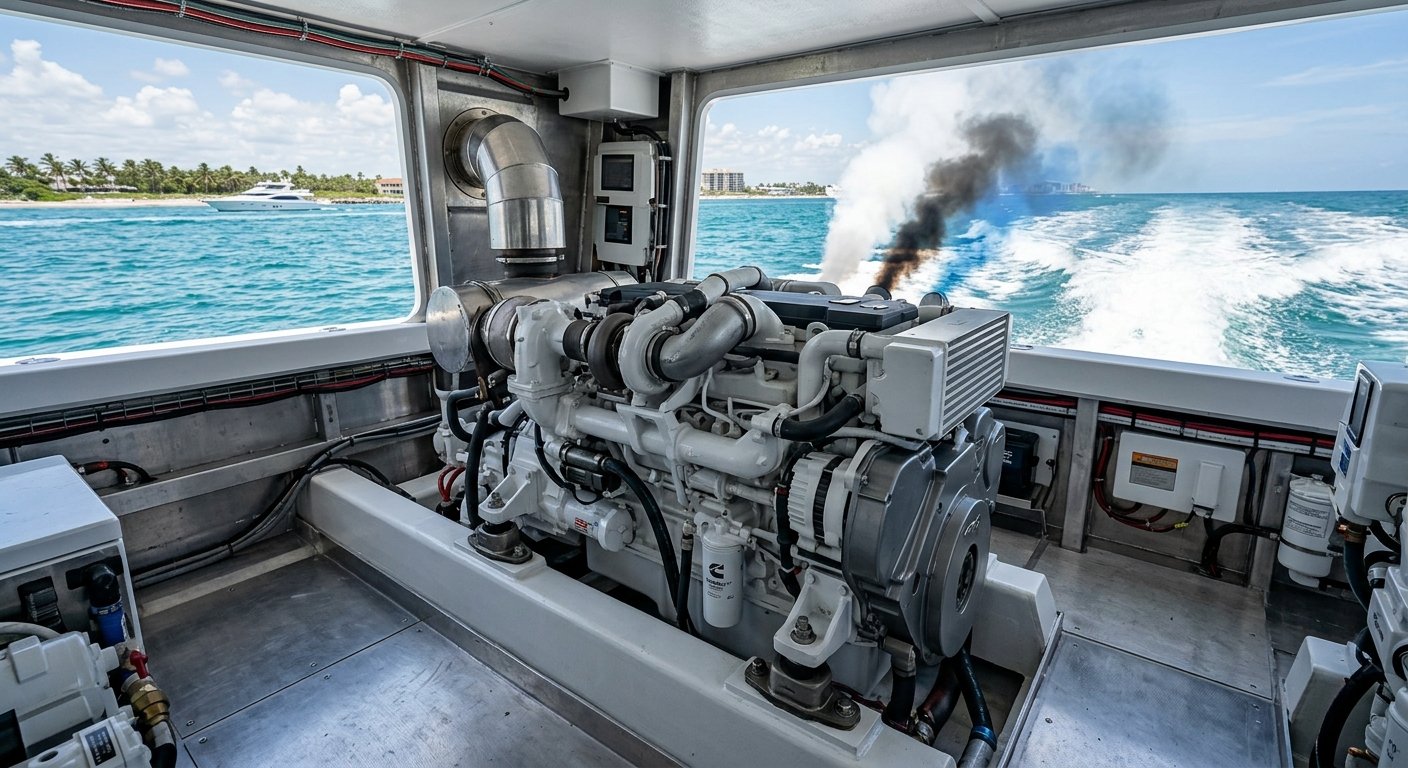
Marine diesel engines operate under conditions that differ significantly from automotive or industrial applications. Saltwater environments accelerate corrosion, variable load demands stress cooling and fuel systems, and engines often sit unused for extended periods between runs — all of which compound the risk of issues that show up in exhaust smoke.
According to the U.S. Coast Guard, mechanical failures remain a leading contributing factor in recreational boating accidents. While exhaust smoke alone doesn’t indicate imminent danger, it frequently signals the kind of progressive mechanical degradation that leads to on-water engine failure if ignored.
The color, density, and timing of exhaust smoke — whether it appears only at startup, under heavy load, or continuously at idle — all inform the diagnosis. None of these variables should be dismissed as “just how older diesels run.”
Black Exhaust Smoke: Too Much Fuel or Too Little Air
Black smoke is the most common exhaust complaint in marine diesel troubleshooting, and it typically points to an imbalance in the air-to-fuel ratio. The engine is burning more fuel than the available air can efficiently combust, leaving unburned carbon particles in the exhaust stream.
Common Causes of Black Smoke
- Clogged air filters: Restricted airflow starves combustion. This is one of the most straightforward causes and among the easiest to address with routine service.
- Faulty or worn injectors: Injectors that are delivering too much fuel, delivering it at the wrong angle, or atomizing it poorly will produce black smoke, often accompanied by a rough idle or loss of power.
- Turbocharger problems: A failing turbo reduces the charge air entering the engine. On turbocharged marine diesels — including many MAN and Volvo Penta models — this is a common culprit behind persistent black smoke under load.
- Engine overloading: Pushing a diesel harder than it’s rated for — through excessive hull fouling, mismatched propellers, or overloading the vessel — can cause temporary black smoke. If it clears when load is reduced, the engine itself may not be the primary issue.
- EGR or emissions system faults: On newer Tier III-compliant engines, malfunctions in the exhaust gas recirculation system can also produce black smoke alongside fault codes.
Occasional, brief black puffs during acceleration aren’t always alarming. Continuous or heavy black smoke at any operating condition warrants a professional inspection.
White or Gray Smoke: Water, Fuel, or Temperature Issues
White or gray smoke is more nuanced — and in many cases, more urgent — than black smoke. The distinction between thin white vapor and dense white or gray smoke matters considerably in diagnosis.
Thin White Vapor at Startup
A light, wispy white vapor on a cool morning or after an engine has been sitting is usually condensation burning off in the exhaust system. This is normal and typically clears within a few minutes of operation. In Southeast Florida’s warm climate, true condensation-related smoke is less common than in cooler regions, so if you’re seeing it mid-day or after the engine is fully warmed up, don’t dismiss it.
Dense White or Gray Smoke During Operation
Persistent white or gray smoke during normal operation is a more serious symptom and commonly indicates one of the following:
- Coolant entering the combustion chamber: This is the most critical scenario. A failed head gasket, cracked cylinder head, or damaged cylinder liner can allow engine coolant to enter combustion, where it vaporizes and exits as white smoke. This is often accompanied by a sweet smell, coolant loss without visible leaks, or milky contamination in the engine oil.
- Fuel system timing issues: Late fuel injection timing prevents complete combustion and can produce white or gray smoke, especially at idle or low load.
- Incomplete fuel combustion: Caused by low compression, worn injectors, or glow plug failures (on engines equipped with them), incomplete combustion produces unburned fuel vapor that appears white or gray in the exhaust.
If you suspect coolant is entering the combustion system, stop operating the engine and have it inspected immediately. Continued operation with coolant intrusion can cause catastrophic internal damage, including hydraulic lock.
Blue Smoke: Oil in the Combustion Chamber
Blue smoke — or bluish-gray smoke with a distinctive acrid, oily smell — indicates engine oil is being burned in the combustion chamber. This is a symptom of internal engine wear or damage and should always be investigated by a qualified technician.
Common Sources of Blue Smoke
- Worn piston rings: As rings wear, oil migrates past them into the combustion chamber. This is common in high-hour engines and engines that have experienced extended idle periods or infrequent use.
- Worn valve stem seals: Deteriorated valve stem seals allow oil to enter the combustion chamber, particularly notable after extended idling or upon acceleration from a stop.
- Turbocharger oil seal failure: A worn turbo can pass oil into the intake air charge, producing blue smoke — often more pronounced at higher RPMs.
- Overfilled oil sump: While less common, an engine with too much oil can push excess oil into areas it shouldn’t be, contributing to blue smoke. Always follow manufacturer specifications for oil level.
Blue smoke that appears only briefly at startup, then clears, may indicate valve seal wear that worsens gradually. Blue smoke that persists throughout operation points to more significant ring or turbo issues. Either way, burning engine oil at an elevated rate will eventually lead to low oil pressure — a direct path to severe engine damage.
What to Do When You See Abnormal Exhaust Smoke
The right response depends on the type of smoke and how your engine is behaving. Here’s a practical framework:
- Document what you observe: Note the smoke color, when it appears (startup, idle, acceleration, sustained load), how long it persists, and any accompanying symptoms such as unusual sounds, reduced power, warning lights, or abnormal temperature readings.
- Check your gauges: Coolant temperature, oil pressure, and engine hours all provide critical context for diagnosis.
- Don’t continue operating if you suspect coolant intrusion or sustained oil burning: These conditions can escalate from a manageable repair to a full engine rebuild in a short time.
- Contact a factory-authorized technician: Many exhaust smoke issues require professional diagnostic equipment and brand-specific expertise to properly evaluate — particularly on sophisticated engines like MAN, Volvo Penta, Cummins, or Kohler, where onboard diagnostic systems interact with engine management.
DSOA offers dockside service throughout Palm Beach and Broward counties, so there’s no need to haul your vessel if it can be safely evaluated at the marina. For more complex repairs, our diesel marine engine repair capabilities cover everything from injector service to full engine rebuilds across all authorized brands.
The Role of Preventive Maintenance
Many exhaust smoke issues are preceded by warning signs that routine service intervals would have caught. According to the American Boat and Yacht Council (ABYC), adherence to manufacturer-recommended maintenance schedules is one of the most effective practices for extending marine engine service life and avoiding unplanned failures.
Air filter replacements, injector testing, fuel system inspections, coolant analysis, and turbocharger checks are all part of a comprehensive marine diesel service program. These services are especially important for vessels operating in the saltwater environments of Southeast Florida and the Caribbean, where heat, humidity, and corrosion accelerate wear.
Frequently Asked Questions
Is a small amount of black smoke normal on my marine diesel?
Brief black puffs during hard acceleration or sudden load changes can occur on diesel engines and aren’t always cause for immediate concern. However, continuous or heavy black smoke at any operating condition — particularly at idle or cruise — indicates a fuel, air, or injector issue that warrants inspection.
What does it mean if my engine smokes only at startup?
Light white vapor at cold startup is usually harmless condensation. Black or blue smoke at startup that clears quickly can indicate valve seal wear, cold-start fuel enrichment issues, or injector problems. If startup smoke is consistent or worsening, schedule a diagnostic inspection.
How serious is white smoke from a marine diesel?
Dense, persistent white smoke during normal operation is one of the more serious symptoms — particularly if it suggests coolant intrusion. Operating an engine with a compromised head gasket or cracked head risks major internal damage. Any white smoke that doesn’t clear within a few minutes of warm operation should be evaluated promptly.
Can I diagnose exhaust smoke issues myself?
You can observe and document symptoms, which is genuinely helpful information for a technician. However, accurate diagnosis requires compression testing, injector analysis, coolant system pressure testing, and in many cases, access to manufacturer diagnostic software. Factory-authorized technicians have the training and tools to correctly identify root causes rather than address symptoms.
How do I find diesel engine repair in Fort Lauderdale or Palm Beach?
DSOA serves both Palm Beach and Broward counties with factory-authorized marine diesel service and dockside availability. Our technicians are certified across major brands including MAN, Volvo Penta, John Deere, Cummins/Onan, Kohler, Northern Lights, and Westerbeke — which matters significantly when diagnosing modern engines with complex electronic management systems.
Schedule a Diagnosis Before a Minor Issue Becomes a Major Repair
Exhaust smoke is your engine telling you something. The difference between a straightforward service call and a major overhaul often comes down to how quickly that signal is acted on. DSOA’s factory-authorized technicians bring four decades of expertise in marine diesel troubleshooting to boat and yacht owners throughout Palm Beach and Broward counties — with dockside service that brings professional diagnostics to your slip.
If your vessel is showing abnormal exhaust smoke or any other performance concerns, contact DSOA to schedule a service visit. We also provide worldwide parts shipping for vessels requiring specific components for authorized brands. Don’t wait for a warning sign to become an emergency.
