
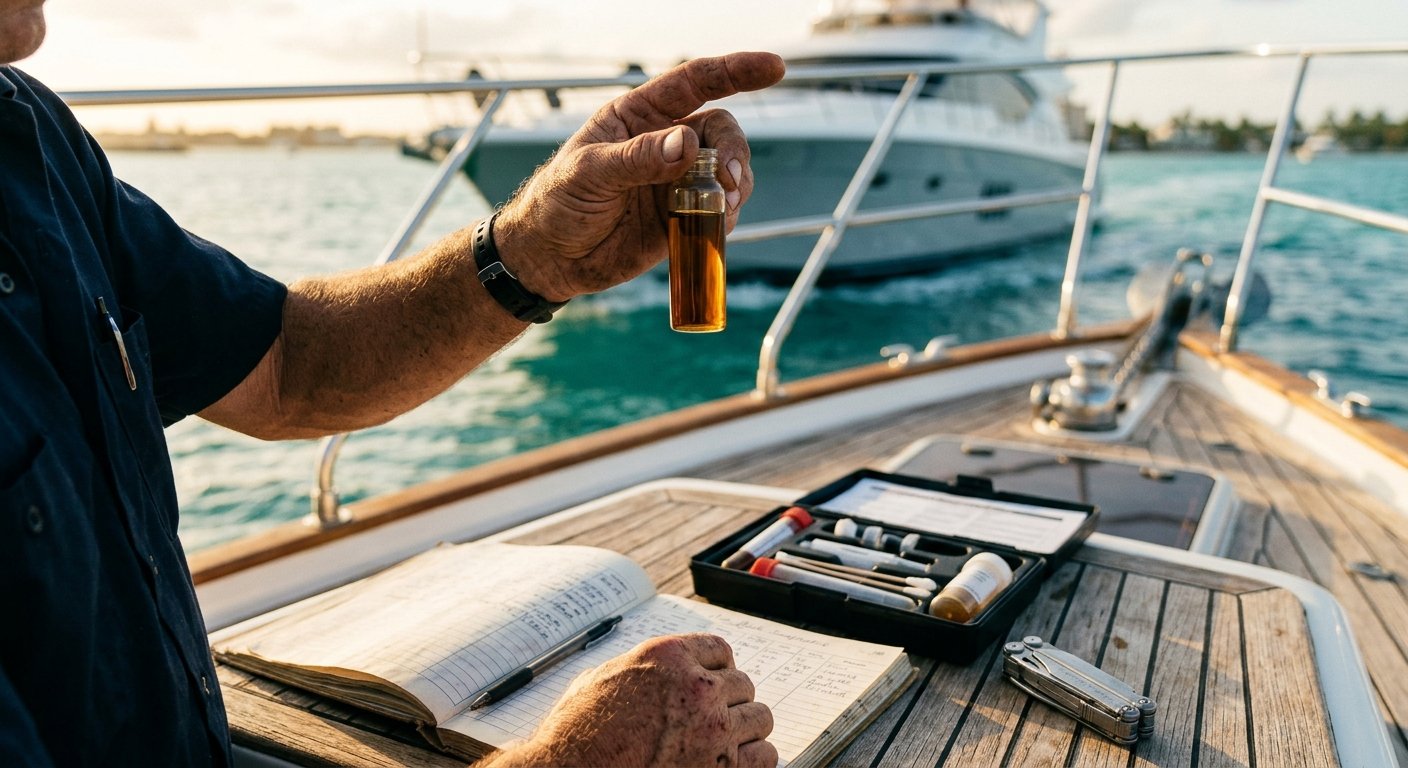
What if a small vial of engine oil could tell you that a critical component is wearing down weeks before it fails—saving you from a breakdown 50 miles offshore? That’s not a hypothetical. Oil analysis is one of the most powerful and underutilized tools in predictive marine engine maintenance, and for yacht owners in Palm Beach and Broward Counties, understanding how it works can mean the difference between a smooth voyage and an expensive emergency repair.
This guide breaks down what marine diesel oil analysis actually is, why it matters, and how it fits into a comprehensive preventive maintenance strategy for your vessel.
What Is Marine Diesel Oil Analysis?
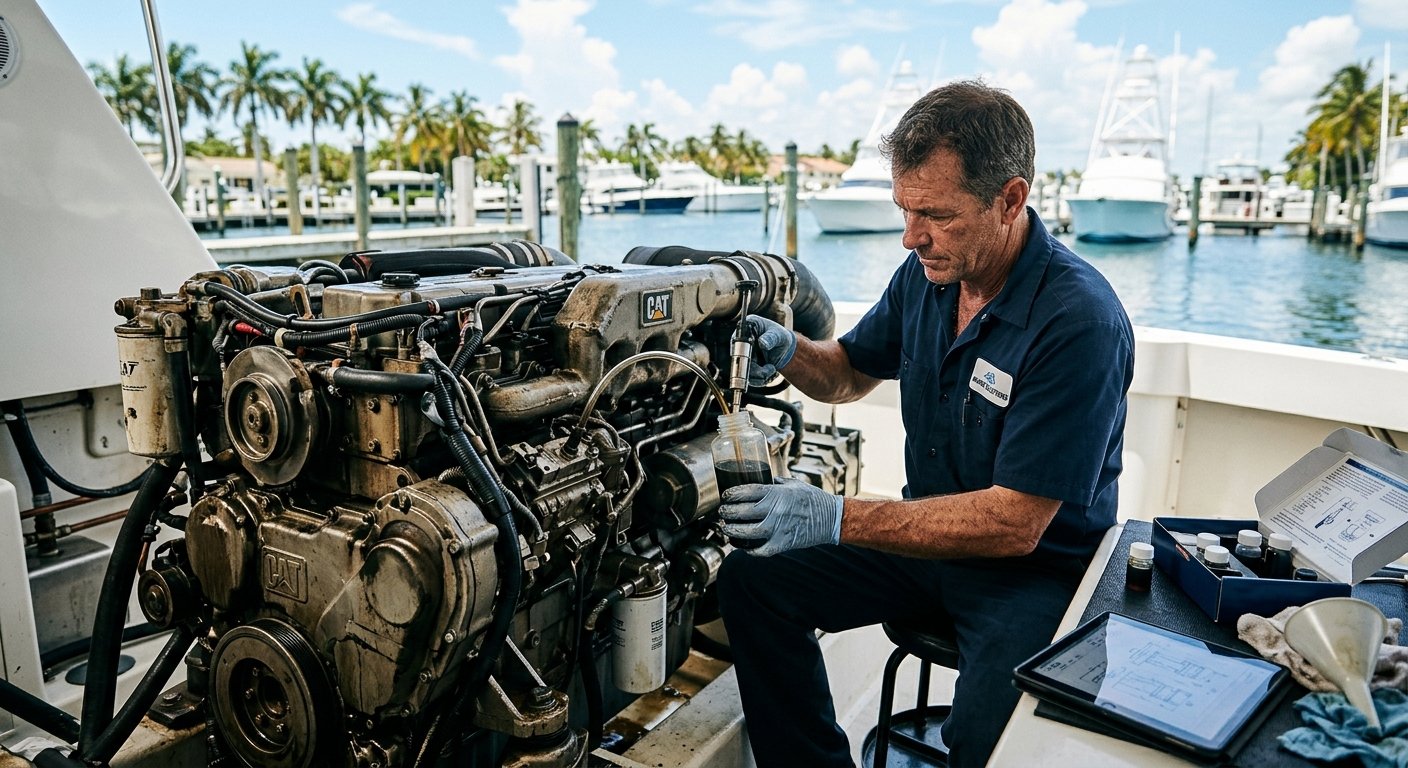
Oil analysis is a laboratory process that examines a sample of used engine oil to identify wear metals, contaminants, fuel dilution, coolant intrusion, and the overall condition of the oil itself. Think of it as a blood test for your engine.
When internal engine components experience normal wear—or abnormal wear caused by an underlying problem—microscopic metal particles and chemical compounds are released into the lubricating oil. A trained lab can identify the source of those particles with remarkable precision. Elevated iron levels may indicate liner or ring wear. High copper content can point to bearing degradation. Silicon contamination often signals a compromised air filtration system or gasket leak.
For marine diesel engines from manufacturers like MAN, Volvo Penta, Cummins/Onan, John Deere, and Kohler, these wear signatures are well-documented. Factory-authorized technicians know exactly what baseline values should look like for each platform—and when a result warrants immediate attention versus continued monitoring.
Why Predictive Maintenance Outperforms Reactive Repairs
The traditional approach to marine engine care is largely reactive: wait for a problem to surface, then address it. Predictive maintenance, by contrast, uses data—including oil analysis results—to anticipate failures before they occur. The economic logic is compelling.
According to the U.S. Department of Energy, predictive maintenance programs can reduce maintenance costs by 25 to 30 percent while simultaneously decreasing breakdowns by as much as 70 percent. In the context of marine diesel engines—where repair complexity, labor, and parts costs are all elevated—those percentages represent substantial real-world savings.
For boat owners in Southeast Florida, the stakes are even higher. Operating in salt-air environments, navigating the Atlantic, or making Caribbean passages means your engines are working in demanding conditions. An undetected issue doesn’t always manifest at the marina—it often surfaces at the worst possible time and place.
What an Oil Analysis Report Actually Reveals
A comprehensive marine diesel oil analysis typically measures several key categories:
Wear Metals
- Iron: Indicates wear from cylinder liners, crankshafts, and camshafts
- Copper and Lead: Associated with bearing wear and bushing degradation
- Aluminum: May signal piston wear or component deterioration
- Chromium: Often tied to ring or liner wear, particularly in high-hour engines
Contaminants
- Silicon: Points to dirt ingestion or failed air/oil seals
- Sodium and Potassium: Classic indicators of coolant intrusion, which is a serious concern in marine environments
- Fuel Dilution: Indicates injector problems or incomplete combustion, both of which accelerate wear
Oil Condition Metrics
- Viscosity: Confirms whether the oil is still within its designed operating range
- Total Base Number (TBN): Measures the oil’s remaining ability to neutralize acidic combustion byproducts
- Oxidation and Nitration: High levels indicate oil degradation from heat or blow-by gases
When these values are trended across multiple samples over time, patterns become visible. A single elevated copper reading might be noise. Three consecutive readings showing rising copper levels demand investigation.
Oil Analysis for Marine Generators
Yacht generators—particularly units from Cummins/Onan, Kohler, Northern Lights, and Westerbeke—are frequently overlooked in predictive maintenance programs. Many owners focus their attention on propulsion engines while generators operate quietly in the background. But generators experience their own wear patterns and are just as susceptible to bearing degradation, coolant contamination, and fuel system issues.
For vessels that rely on generators to power air conditioning, navigation equipment, and onboard systems during extended passages or at anchor, an unexpected generator failure can compromise safety and comfort. Incorporating generator oil analysis into your maintenance schedule ensures these critical systems receive the same level of scrutiny as your main engines.
How Frequently Should You Analyze Oil?
The appropriate sampling frequency depends on several factors: engine hours, operating profile, engine age, and manufacturer recommendations. As a general framework:
- High-use vessels (liveaboards, charter operations, commercial use): Every oil change interval or every 250 hours
- Moderate-use recreational yachts: Once or twice per season, aligned with oil change intervals
- Vessels returning from extended passages: Immediately upon return, before oil is changed
- Newly acquired vessels: At the first oil change after purchase, regardless of stated history
The American Boat and Yacht Council (ABYC) provides technical standards that support systematic maintenance documentation practices for recreational and commercial vessels. Following structured intervals aligns with those professional standards and builds the historical data needed to make oil analysis truly predictive rather than merely diagnostic.
Integrating Oil Analysis into a Complete Marine Engine Inspection
Oil analysis is a powerful tool, but it works best as part of a broader marine diesel service and inspection program. It complements—rather than replaces—visual inspections, performance monitoring, coolant analysis, and scheduled component checks.
A thorough marine engine inspection conducted by factory-authorized technicians integrates oil analysis findings with direct assessment of fuel injectors, heat exchangers, impellers, belts, zincs, and exhaust systems. When a technician has both oil analysis data and hands-on access to your engine, they can interpret findings with far greater accuracy than either method provides independently.
For yacht owners in Fort Lauderdale and surrounding Broward County, DSOA’s dockside service capability means this comprehensive inspection process can happen at your slip—no haul-out required, no disruption to your schedule. Our on-site diesel marine engine service brings factory-authorized expertise directly to your vessel.
The Role of Factory Authorization in Accurate Interpretation
Not all oil analysis interpretation is equal. Knowing that copper is elevated is only the beginning—understanding whether that elevation is a concern for a specific MAN V8 at 1,200 hours versus a Volvo Penta IPS system at 400 hours requires manufacturer-specific knowledge and technical training.
Factory authorization means DSOA technicians are trained directly by engine manufacturers and have access to proprietary service data, technical service bulletins, and platform-specific wear limits. According to EPA guidance on marine engine maintenance, proper maintenance by qualified technicians plays a direct role in engine longevity and emissions compliance. This isn’t simply a marketing distinction—it translates directly to the quality and accuracy of maintenance recommendations your vessel receives.
Frequently Asked Questions
What does marine diesel oil analysis cost, and is it worth it?
Laboratory oil analysis typically ranges from $25 to $75 per sample depending on the scope of testing. When weighed against the cost of a major engine overhaul—which can run into tens of thousands of dollars—the value proposition is clear. Early detection of a developing bearing issue or coolant leak can allow for a planned, cost-controlled repair rather than an emergency replacement.
Can I perform oil analysis myself, or does it require a professional?
Oil samples can be collected during an oil change, but proper sampling technique matters—cross-contamination or improper labeling can skew results. More importantly, interpreting results accurately within the context of your specific engine, its service history, and its operating profile requires professional expertise. A factory-authorized marine diesel technician ensures samples are collected correctly and that results are acted upon appropriately.
Does oil analysis replace regular oil changes?
No. Oil analysis informs maintenance decisions—it doesn’t eliminate the need for regular oil changes. In fact, samples should generally be taken just before a scheduled oil change to capture the full wear profile of that service interval. The oil is then changed as scheduled, maintaining proper lubrication protection.
Which engines and generators does DSOA service in Southeast Florida?
DSOA is factory-authorized to service MAN, Volvo Penta, John Deere, Cummins/Onan, Kohler, Northern Lights, and Westerbeke marine diesel engines and generators. We serve boat and yacht owners throughout Palm Beach County and Broward County, with dockside service available and worldwide parts shipping for vessels in the Caribbean.
How soon will I receive oil analysis results?
Most marine oil analysis laboratories return results within 3 to 7 business days. DSOA works with established labs and will review and explain your results, providing specific maintenance recommendations based on your engine platform and findings.
Making Predictive Maintenance Work for Your Vessel
The goal of predictive maintenance isn’t perfection—it’s intelligence. Oil analysis gives you and your service team a data-driven view of what’s happening inside your engines between service intervals. Combined with routine preventive marine engine maintenance and professional inspections, it dramatically improves your ability to plan repairs, budget accurately, and keep your vessel performing at its best.
Boat engine maintenance in Fort Lauderdale and throughout Southeast Florida is a year-round responsibility given the active boating season. The vessels that hold their value, perform reliably on passage, and avoid costly emergency repairs are almost always the ones with disciplined, documented maintenance histories—and oil analysis is a cornerstone of that approach.
Whether you’re managing a long-range passage yacht, a sportfishing vessel, or a large motoryacht, DSOA brings four decades of factory-authorized marine diesel expertise directly to your dock. Contact our team today to schedule a comprehensive marine engine inspection or to discuss incorporating oil analysis into your ongoing preventive maintenance program.
