
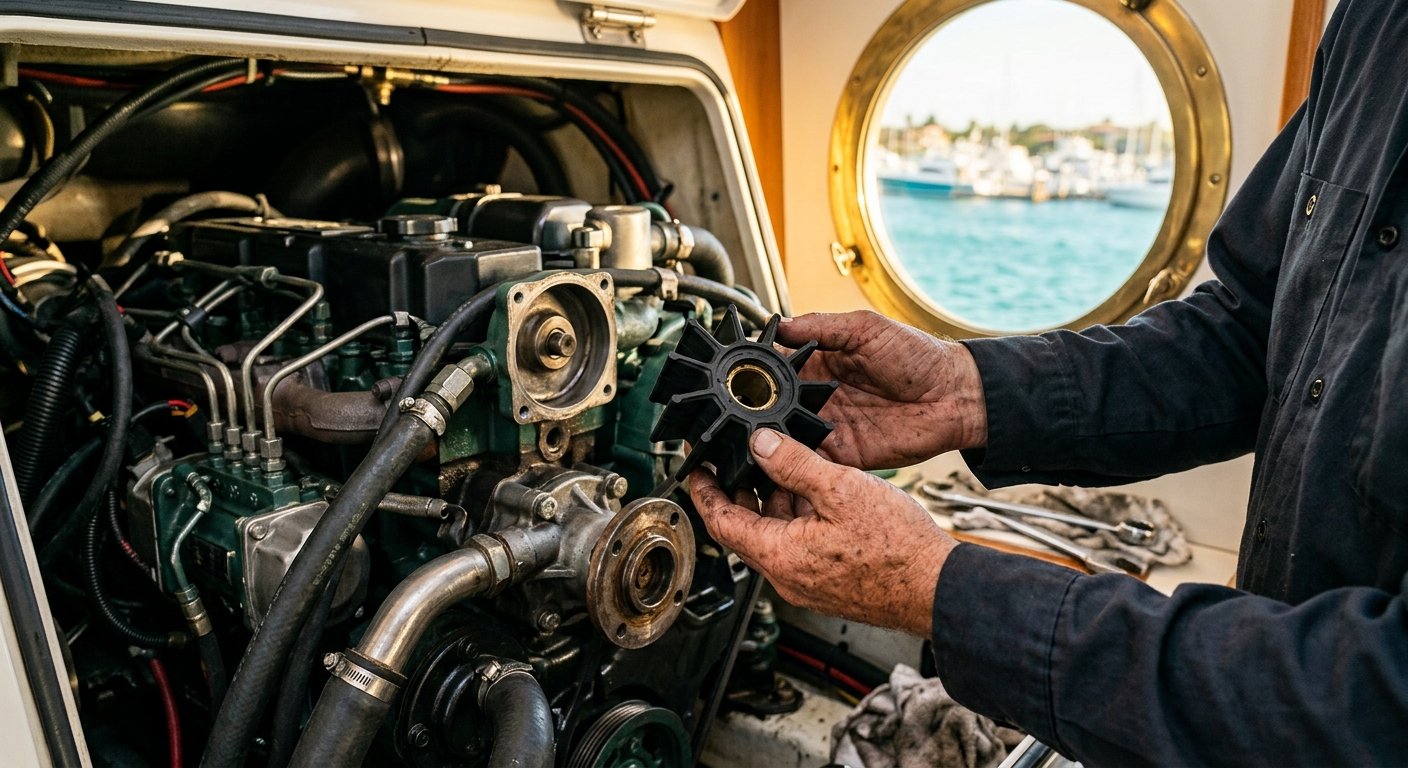
The raw water pump is one of the most critical—and most commonly neglected—components in a marine diesel cooling system. It circulates seawater through the heat exchanger to keep engine temperatures in check. For diesel-powered vessels in Southeast Florida and the Caribbean, routine inspection and timely impeller replacement are essential to avoiding overheating and costly engine damage.
- The raw water pump impeller is a wear item that requires scheduled replacement—not just reactive service when it fails.
- Running a raw water pump dry, even briefly, can destroy the impeller and damage downstream components.
- Salt water, debris, and prolonged idle periods accelerate impeller degradation in Florida and Caribbean waters.
- Factory-authorized technicians can inspect the full cooling circuit during pump service, catching related issues early.
- Dockside service is available throughout Palm Beach and Broward counties, minimizing vessel downtime.
What the Raw Water Pump Actually Does
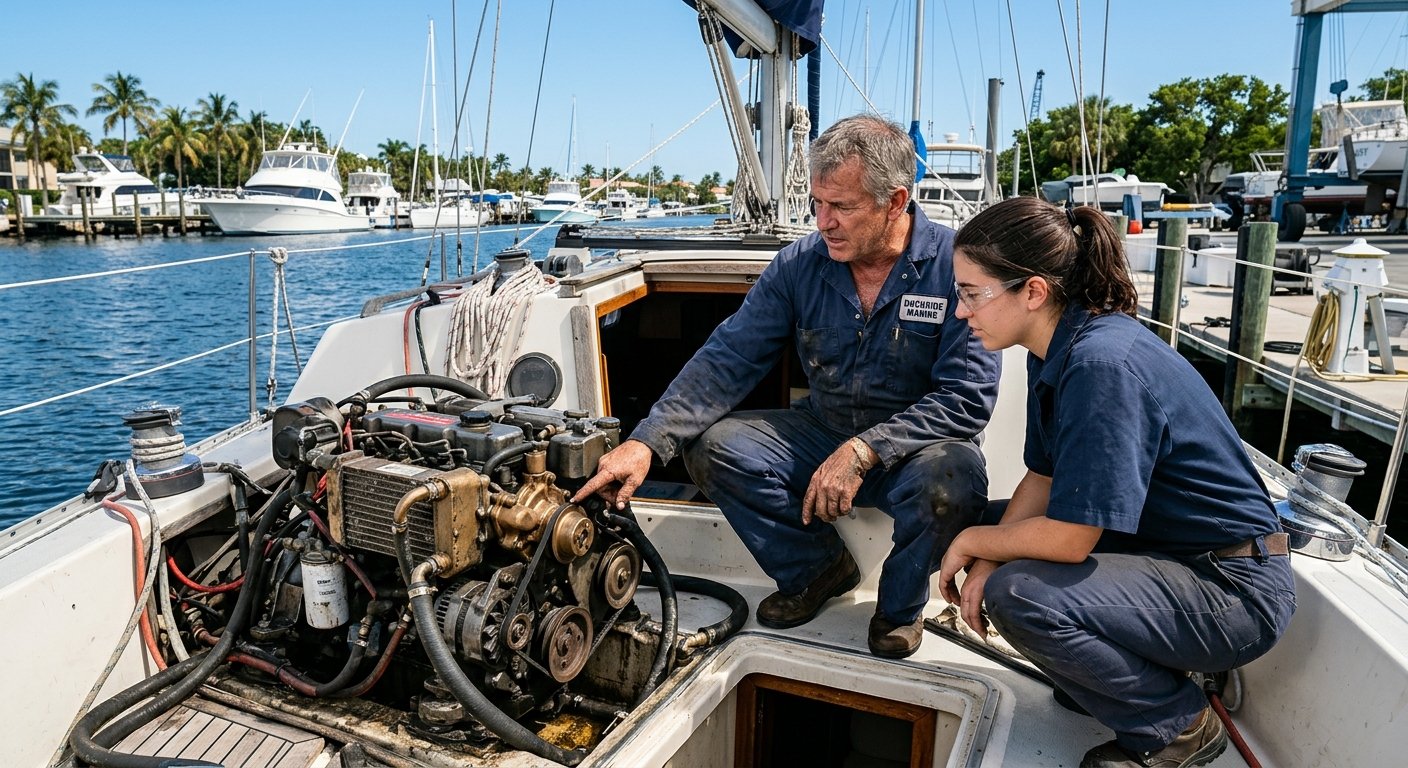
Marine diesel engines use a two-circuit cooling system. The raw water circuit pulls in ambient seawater—or other surrounding water—and sends it through a heat exchanger or directly through the engine, where it absorbs heat before being discharged overboard with the exhaust. The raw water pump drives this entire process.
Unlike the freshwater (closed-loop) side of the system, the raw water side is exposed to everything in the surrounding water: salt, silt, biological growth, and small debris. That exposure is why the components on this side of the cooling system wear faster and require more frequent attention than their freshwater counterparts.
The pump’s rubber impeller is the heart of the system. Its flexible vanes create suction and move water continuously while the engine runs. The material is engineered to be durable under constant flex, but it is still a consumable part with a finite service life.
Never run a marine diesel engine without confirming water flow through the raw water circuit first. Dry-running a raw water pump for even 30 to 60 seconds can shred the impeller and send rubber fragments through the heat exchanger, thermostat housing, and exhaust elbow—turning a simple impeller replacement into a much larger repair job.
How Often Should the Impeller Be Replaced?
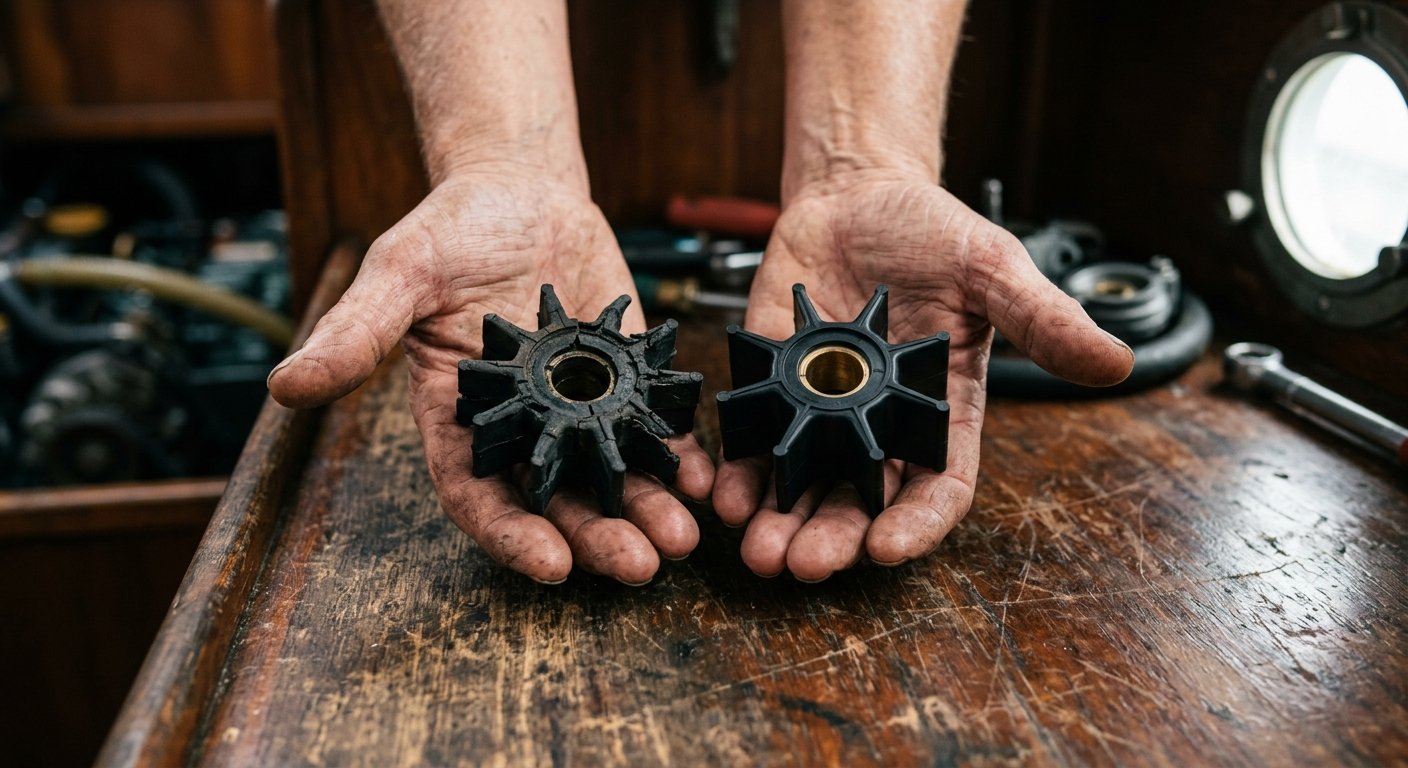
Most engine and pump manufacturers recommend inspecting the raw water pump impeller annually and replacing it at least every one to two years, regardless of visible condition. This cadence reflects the reality that rubber impellers develop micro-cracks and take compression sets over time—failure modes that aren’t always obvious until the impeller comes apart inside the pump housing.
For vessels operating year-round in the warm, biologically active waters off Southeast Florida and the Caribbean, annual replacement is the better standard. Higher engine hours, frequent use in shallow areas with silty water, or extended periods at the dock without running the engine all accelerate wear.
The BoatUS Foundation’s Seaworthy magazine has consistently identified cooling system failure as one of the leading causes of on-water engine problems. Raw water pump failure sits at the center of many of those incidents.
Visual Inspection
Remove the pump cover and inspect impeller vanes for cracks, missing pieces, or a permanent set (vanes that no longer spring back). Even a single missing vane fragment means the impeller must be replaced immediately—and the rest of the cooling circuit inspected for debris.
Check the Pump Housing and Wear Plate
Scoring or grooves on the interior housing wall or the wear plate reduce pumping efficiency. A new impeller in a worn housing will underperform and fail faster than expected. A factory-authorized technician assesses both components together.
Inspect the Shaft Seal
The shaft seal prevents raw water from migrating along the drive shaft and into the engine or bilge. A weeping seal is often detected only during a hands-on inspection—not from the helm. Replacing it during a pump service is straightforward and far less expensive than addressing the water intrusion damage it causes if ignored.
Confirm Correct Impeller Specification
Impellers are not universal. Diameter, number of vanes, and elastomer compound vary by engine brand and model. Using a non-OEM impeller on a MAN, Volvo Penta, Cummins, or Kohler engine risks misfit, accelerated wear, and potential warranty implications on newer engines. Always verify you have the correct marine engine cooling parts for your specific unit.
Warning Signs That Demand Immediate Attention

Between scheduled service intervals, watch for these indicators that the raw water pump or its circuit needs attention:
- Rising coolant temperature gauge — The most direct sign of reduced raw water flow. Do not dismiss a gauge that trends slightly higher than normal at cruising speed.
- Reduced or absent exhaust water discharge — On wet-exhaust systems, water should flow steadily with exhaust gases. A dry or intermittent discharge is a red flag.
- Alarm activation — Modern MAN, Volvo Penta, and Cummins engines have temperature and flow monitoring with alarm systems. An alarm is never a nuisance; it’s a diagnostic message.
- Unusual resistance on pump rotation — When checked manually during service, a pump that turns with difficulty may have debris lodged in the housing or a failing bearing.
- Discolored or contaminated coolant — In some configurations, a failed heat exchanger can allow raw water and coolant to mix. This shows up as milky or gritty coolant and requires immediate marine diesel troubleshooting by a qualified technician.
A raw water pump that fails quietly at the dock is an inconvenience; one that fails underway in the Gulf Stream is an emergency.
The Broader Cooling System Context
The raw water pump doesn’t operate in isolation. When performing pump service, a thorough inspection should extend to the full raw water circuit: the sea strainer, raw water hoses and clamps, the heat exchanger, the thermostat, and the exhaust elbow. Any one of these components can create a restriction or failure point that the pump cannot compensate for.
According to the U.S. Coast Guard’s boating safety resources, mechanical failure—including propulsion and cooling system problems—remains a leading category of on-water assistance calls. Preventive maintenance that addresses the full system, rather than individual parts in isolation, is the most reliable way to reduce that risk.
DSOA’s factory-authorized technicians service the complete cooling circuits on MAN, Volvo Penta, John Deere, Cummins/Onan, Kohler, Northern Lights, and Westerbeke engines and generators. When a raw water pump service is performed, the broader system is evaluated at the same time—the kind of comprehensive approach that catches a compromised heat exchanger before it becomes an engine rebuild. Learn more about what comprehensive diesel marine engine repair looks like when performed to factory standards.
Keep a spare impeller of the correct specification aboard your vessel. In a situation where a technician is already on-site or you’re awaiting a service call, having the right part immediately available can be the difference between a same-day resolution and an extended delay waiting on parts. DSOA also ships marine engine cooling parts worldwide for owners who need components for remote locations in the Caribbean.
Why Factory-Authorized Service Matters for Pump Work
Raw water pump service may seem straightforward, but the standards that apply to each engine brand are specific. A Volvo Penta IPS drive has different service protocols than a John Deere-based propulsion system or a Northern Lights generator. Factory-authorized status means technicians are trained and equipped to the manufacturer’s actual specifications—not generic marine repair practices.
For boat and yacht owners in Palm Beach and Broward counties, DSOA’s on-site dockside service means pump inspections and impeller replacements can be completed at your marina without hauling the vessel. That convenience factor matters for owners who use their boats regularly and can’t afford extended downtime or the logistics of a boatyard visit for routine maintenance.
For vessels operating in the Caribbean or planning extended offshore passages, DSOA’s worldwide parts shipping capability ensures that owners can source OEM-correct marine engine pumps and components wherever they’re located—with the confidence that the specification is right for their engine. Explore marine engine sales and parts availability for vessels requiring authentic replacement components.
Aftermarket impellers may be physically compatible but are often manufactured with different elastomer formulations than the OEM specification. In high-temperature, high-salinity operating environments like South Florida and the Caribbean, that material difference can significantly shorten service life and increase the risk of in-season failure.
Frequently Asked Questions
How do I know if my raw water pump impeller has already failed?
The most common signs are an elevated coolant temperature gauge, reduced water discharge from the exhaust, or an engine temperature alarm. If any of these occur, shut down the engine as soon as safely possible and arrange for a professional marine diesel troubleshooting inspection before restarting. Running with a failed impeller causes cascading damage through the cooling circuit.
Can I replace the impeller myself?
While impeller access varies by engine model, the physical replacement is only part of the service. Confirming the correct OEM specification, inspecting the wear plate and shaft seal, clearing any debris from the cooling circuit, and verifying system function afterward all require the knowledge and tools that factory-authorized technicians bring to the job. Incomplete service can leave the system vulnerable despite a new impeller.
How often should I have the full raw water cooling system inspected?
An annual inspection of the complete raw water circuit—including the sea strainer, hoses, heat exchanger, thermostat, and exhaust elbow—is standard practice for vessels in active service. Higher-hour vessels or those operating in sediment-heavy waters may benefit from more frequent checks. This inspection is typically performed as part of a scheduled boat engine maintenance visit.
Does raw water pump service apply to marine generators too?
Yes. Marine generators from Cummins/Onan, Kohler, Northern Lights, and Westerbeke all use raw water cooling circuits with impeller-driven pumps. Generator impellers are subject to the same wear mechanisms as propulsion engine pumps and should be on the same maintenance schedule. A generator that overheats due to a failed raw water pump can shut down without warning—a significant problem when it’s powering critical systems offshore.
What is the risk of deferring raw water pump service?
Deferred service significantly increases the probability of in-season impeller failure. When an impeller fails, rubber fragments travel downstream and can lodge in the heat exchanger, thermostat housing, and exhaust elbow. Clearing these fragments and inspecting for heat damage to the engine typically costs far more than the original scheduled service would have. The National Marine Manufacturers Association notes that proper maintenance is central to vessel reliability and long-term value retention.
Schedule Your Raw Water Pump Service
DSOA’s factory-authorized technicians serve Palm Beach and Broward County marinas with dockside marine diesel service—bring the expertise to your vessel, not the other way around.

About DSOA
DSOA provides factory-authorized marine diesel engine and generator maintenance, repair, and parts services to boat and yacht owners throughout Southeast Florida and the Caribbean. With four decades of expertise servicing premium brands including MAN, Volvo Penta, John Deere, Cummins/Onan, Kohler, Northern Lights, and Westerbeke, DSOA combines authoritative technical knowledge with convenient dockside service. The company serves both experienced yacht owners and newer boaters with professional, educational guidance on proper engine care and preventive maintenance, backed by worldwide parts shipping capability. Visit dieselservicesofamerica.com →
